A composite class brings children from more than one year level into the same classroom. Before deciding whether the arrangement suits your child, ask which years are combined, how teaching will meet their learning needs and how progress will be assessed. The class label alone cannot answer those questions.
This is an established part of schooling, rather than a new experiment everywhere it appears. The NSW Department of Education's 2024 dataset records 7,408 multi-age or composite classes with 173,488 students. Those are historical NSW government-school figures, not a current national count or a measure of teaching quality.
Key takeaways
- Composite, multi-age and stage classes can describe different arrangements. Ask what your school means.
- A mixed-year class doesn't, by itself, mean a child has skipped or repeated a year.
- Ask for an example of teaching, assessment and support for your child's learning needs.
- Our analysis of the NSW 2024 dataset finds 1,567 school records with at least one composite class.
- Use the questions below to agree on a learning plan and a follow-up conversation, rather than judging the room by its name.
What is a composite class?
A composite class combines students from different year levels. Schools may also use terms such as multi-age, mixed-year or stage class. The Queensland Curriculum and Assessment Authority's research summary explains that terminology varies. Ask the school to describe the actual group and its teaching approach, rather than assuming all these names mean the same thing.
A class called Year 3/4, for example, usually includes children enrolled in those two years. It doesn't tell you how often they learn together, how groups change between subjects or which work an individual child receives. Those details need a conversation with the teacher or school leader.
There is also a useful NSW distinction. The official curriculum stage mapping places Years 1–2 in Stage 1 and Years 3–4 in Stage 2. A NSW Year 3/4 class sits within a stage; a Year 2/3 class crosses stages. This is an illustration of NSW terminology, not a national placement rule. The linked page is registration guidance; we use it here only for its stage definitions.
Why do schools form composite classes?
Schools can combine years because enrolment numbers don't divide neatly into separate classes, because the school is small, or because they choose a multi-age approach. NSW Education's multistage-programming resource distinguishes enrolment-driven composite groupings from broader multi-age arrangements. Ask why this particular class was formed and how the school planned for it.
The answer matters more than a general defence of mixed-year teaching. A school forming a combination for the coming year needs a clear plan for that group. A school that routinely uses multi-age classes should be able to explain how it manages learning over successive years.
Neither explanation automatically establishes that the class is right or wrong for your child. A useful follow-up is: “What will the teaching look like for a child working at my child's current level?” That moves the discussion from the timetable to the learning.
What does the NSW data actually show?
The NSW government dataset records 7,408 composite classes and 173,488 students in 2024. AroundSchools counted 1,567 unique school records with a positive composite-class count in that year's columns. We excluded the statewide total row when counting schools, and checked that the school-level class and student sums match the published statewide totals.
That is a measure of recorded use, not effectiveness. It doesn't show how a particular teacher groups children, how well a child is progressing, or what classes the school will run in 2027. We haven't turned the historical school list into a percentage of all schools, or treated these NSW figures as an Australian total.
The practical takeaway is modest: a composite placement is not inherently unusual. You still need to understand the local teaching plan. If you're comparing schools, ask each the same questions so you can compare their answers, rather than placing one school's class label against another school's marketing language.
How can children learn different year levels in one room?
Teachers need a plan for what is shared, what is taught separately and how each child's learning is checked. ACARA's planning guidance outlines several models, including connecting concepts across years, organising selected content over an A/B cycle and using split approaches. These are planning options, not a guarantee that every school uses the same method.
For a concrete conversation, ask the teacher to walk through a recent lesson. What was the common idea? What changed between tasks? What help or extension was available? What did the teacher look at afterwards to decide the next step? These are our suggested questions, rather than a checklist that officially grades a school.
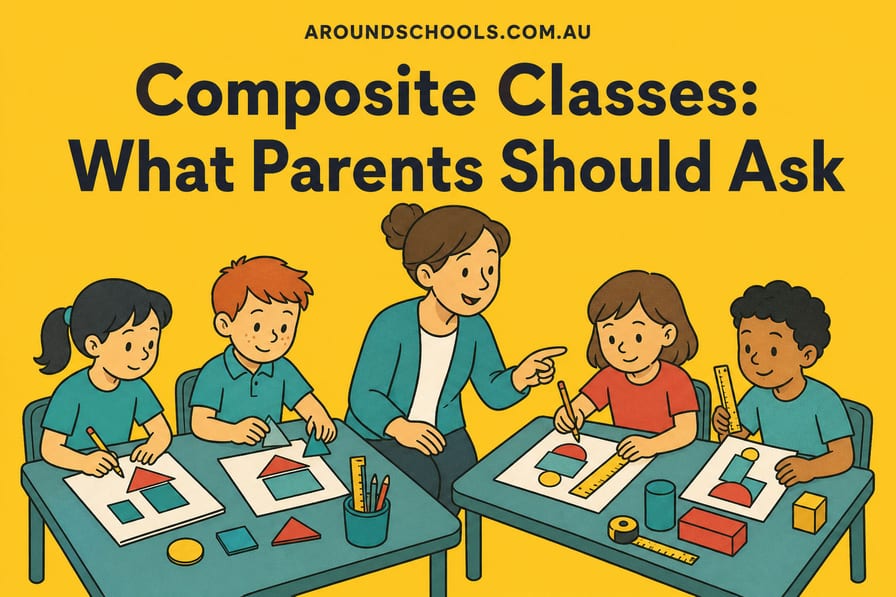
Imagine a shared activity involving shapes. Children might have different tasks, explanations or levels of support. That is an illustrative example, not a description of a particular school's program. The useful evidence is the example your child's teacher can show, including how it connects to the curriculum they teach.
If the school uses a cycle across years, ask how it avoids gaps and unnecessary repetition, including for children joining partway through. Don't assume “we cover it over two years” answers every question about learning this year.
Eight questions to take to the school
Bring questions about your child, rather than asking staff to defend every composite classroom. These 8 questions are AroundSchools' conversation guide. Start with the concern that matters most to your family and ask for a concrete example, a next step and a suitable time to review it.
- Which year levels are together, and why was this structure chosen? Clarify whether the arrangement is planned for this year or part of the school's usual approach.
- What is my child working towards in English and maths? Ask how the teacher identifies their starting point and selects the next learning steps.
- When will children learn together and when will they work in smaller groups? Ask how groups are decided and whether they change as learning needs change.
- How will you assess and report my child's progress? Ask what work, observations or other evidence you will discuss together.
- What support and extension will be available? Explain any existing adjustments or learning goals so the conversation stays specific.
- How will friendships and belonging be supported? Ask about opportunities to spend time with both classmates and same-year peers.
- What planning support does the teacher have? Ask about collaboration, resources and experience with this class structure.
- When should we review how things are going? Agree on how to raise a concern and what information would help the discussion.
If your child needs particular communication, sensory or learning support, share the strategies that already work. The conversation should cover participation and appropriate teaching, rather than relying on whether the class is described as single-year or composite.
Are composite classes better or worse academically?
A class label cannot predict an individual child's results. QCAA's November 2023 research summary discusses potential opportunities and challenges across studies with different settings and approaches. It is an official synthesis, not a new national trial proving a guaranteed advantage or disadvantage for every Australian child.
Possible opportunities such as collaboration need to be deliberately supported. Challenges such as planning for different learning needs also need a response. Ask how the school will monitor your child's progress and respond if the work is too easy, too difficult or poorly matched. A confident general statement is less useful than an example and a review plan.
For a broader school decision, our private-primary-school comparison considers another part of the choice. Our guide to interpreting NAPLAN results helps you frame questions about published results. Neither can tell you how a particular composite room will work next year.
Frequently asked questions
Is being in the younger year the same as acceleration?
No: sharing a room with an older year does not itself establish that a child has formally moved ahead. Ask which year your child is enrolled in and what learning they are working towards. If the school proposes a separate acceleration arrangement, ask it to explain that process specifically.
Will the older children repeat everything?
They shouldn't be assumed to receive a repeat simply because younger children share the room. Ask the school to explain the learning sequence, how it builds on prior work and how the teacher checks progress. ACARA's guidance explicitly treats avoiding gaps and unnecessary repetition as a planning issue.
Can I ask for a different class?
You can discuss a placement request with the teacher and ask how reviews work. Explain the particular learning or wellbeing issue rather than assuming a change is guaranteed. Ask what can be addressed in the current plan and who will discuss any further request with you.
Should we buy extra tutoring because of a composite placement?
The class name alone doesn't establish a tutoring need. Ask the teacher about your child's progress and next learning steps first. If you consider outside support, ask what specific goal it addresses and how it fits with schoolwork. AroundSchools' activity directory can help you explore options; a listing isn't evidence that extra classes are needed.
Your next step
Write down your main concern, take the questions to school and ask for a practical example of the learning plan. If your child is starting primary school, our school readiness checklist can help with daily routines. Use each guide for the decision it addresses, rather than trying to judge a whole school from one classroom arrangement.
Sources and method
Checked on 18 October 2026. Official sources: NSW Department of Education's multi-age/composite dataset and multistage-programming resource; NSW Government curriculum stage mapping; QCAA's November 2023 research summary; and ACARA's multi-age planning guidance. Links appear beside the relevant claims. Dataset figures describe 2024, the latest year in that dataset at retrieval. The 1,567 school count is AroundSchools' calculation from positive 2024 class-count records, excluding the statewide summary. The 8 parent questions are editorial suggestions, not a validated school-rating instrument. No achievement effect or current national prevalence is claimed.