Free Eye Tests and Glasses for Kids in Australia: What Each State Provides in 2026
21 September 2026
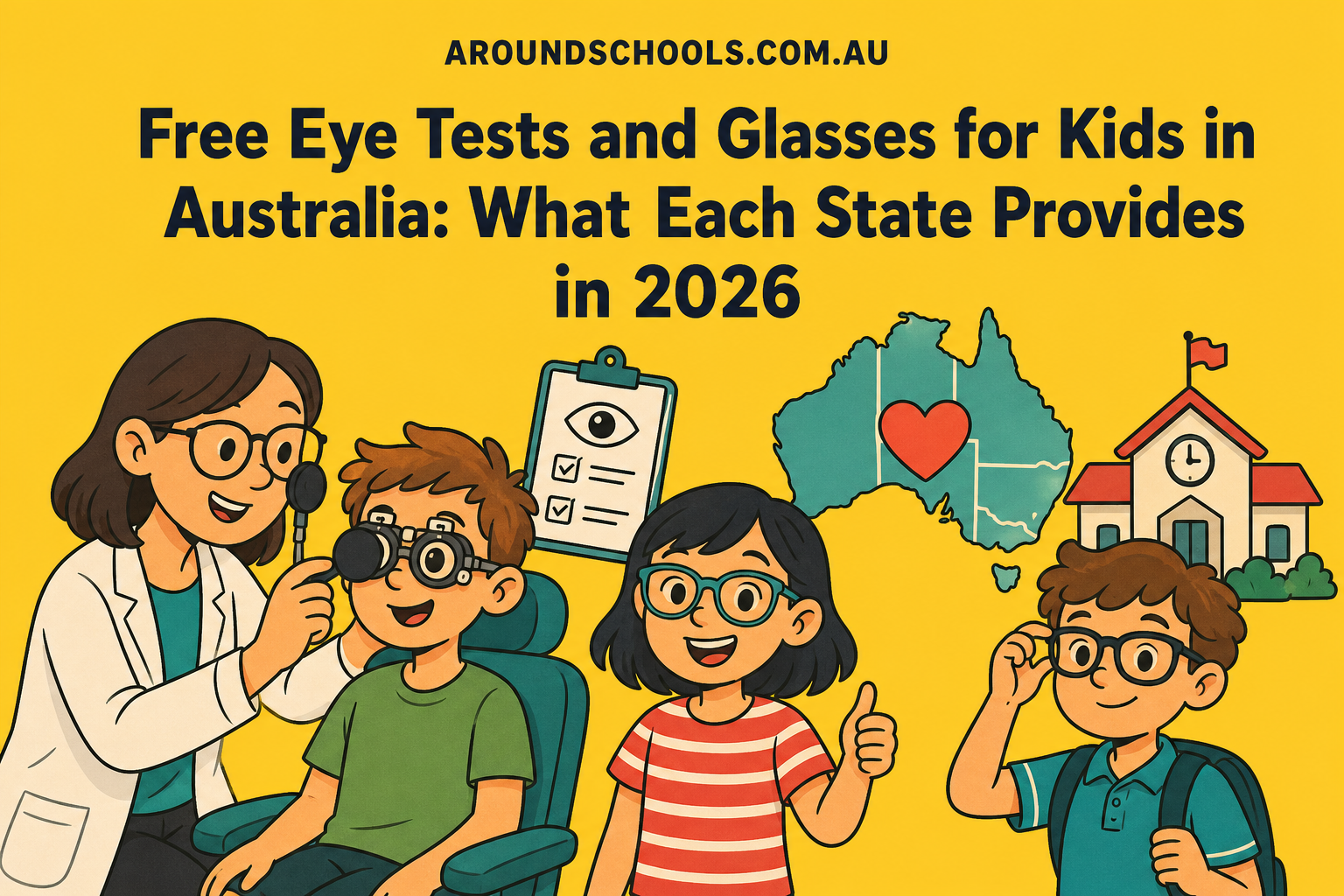
Any Australian child with a Medicare card can have a full eye examination by an optometrist, and it costs the family nothing when the optometrist bulk bills. Medicare's schedule fee for that consultation is $79.80 and the benefit it pays is $67.85. On top of that, every state and territory has a public health check before school that includes sight and hearing, and Queensland, Western Australia and the ACT check again in the first year of school. Only Victoria then puts free glasses on children's faces at school.
Three different things get muddled here, so it is worth separating them before anything else. A screening is a short check designed to find the children who need a proper look. An eye examination is the real thing, done by an optometrist, and Medicare pays for it. Glasses are a third question again — Medicare does not cover them, and in most of the country they are the family's own cost unless you hold a concession card.
Key takeaways
- Medicare pays for a comprehensive optometry consultation once every three years for anyone under 65 — MBS item 10910, schedule fee $79.80, benefit $67.85. If the optometrist bulk bills you pay nothing, but bulk billing is their choice, so ask when you book. No GP referral is needed.
- If your child is turning four and you get Family Tax Benefit Part A plus an income support payment, a health check may be compulsory. Services Australia's own words: if the check does not happen, "your Family Tax Benefit (FTB) Part A payment rate may reduce". That check includes sight and hearing.
- Queensland, WA and the ACT screen again in the first year of school, at the school, by nurses, and only with a signed consent form. NSW screens earlier — at four, in preschools and long day care.
- Victoria is the only place we could find that supplies free glasses through schools. Glasses for Kids covers Prep to Grade 3 at participating schools, and the child picks their own frames.
- Free hearing services are national and generous: under 26 and fully subsidised — but children on temporary visas are excluded from the main program.
What Medicare covers, anywhere in Australia
This part applies to every family reading, whatever the postcode.
An optometry consultation is a Medicare item like a GP visit. The one that matters for a child's first proper eye examination is MBS item 10910: a professional attendance of more than 15 minutes, "being the first in a course of attention", where the patient is under 65 and has not had an equivalent service in the previous 36 months. Its schedule fee is $79.80, and because optometry benefits are paid at 85% of the schedule fee, the Medicare benefit is $67.85. That fee was last updated on 1 July 2026.
In practice:
- If the optometrist bulk bills, you pay $0. Bulk billing means they accept the Medicare benefit as full payment. Plenty of practices do, including most of the big chains — but it is not compulsory, so confirm it when you book rather than at the counter afterwards.
- If they do not bulk bill, you pay their fee and Medicare refunds $67.85. The gap is whatever they charge above the schedule fee.
- The three-year limit applies to that comprehensive first consultation, not to every visit. If an optometrist asks to see your child again, follow-up visits within a course of care are billed under different items.
- If you switch optometrists inside those three years, the new practice bills item 10907 instead — schedule fee $40.00, benefit $34.00.
- Medicare does not pay for glasses. The test is covered; lenses and frames are not. That gap is what the state schemes below try to fill.
The check at four that can cost you money
This one surprises people, and it is worth two minutes.
Under the Healthy Start for School requirement, a child turning four may need a health check if both of these apply: the child is turning four, and you or your partner receive Family Tax Benefit Part A and an income support payment. Services Australia states the consequence plainly: "If your child doesn't have a health check, your Family Tax Benefit (FTB) Part A payment rate may reduce." If it applies to you, they send a letter through your myGov inbox or by post first.
What the check covers, in their words: "an assessment of your child's physical health. It includes their height, weight, hearing, sight and general wellbeing." A child can have it from the day they turn three, and a GP or community health clinic can do it.
The useful detail is that each state and territory has its own check that satisfies the requirement, usually the one your nurse is already doing:
| Where | The check that counts |
|---|---|
| NSW | A check at 3 to 4, recorded in My First Health Record — or a four-year-old health and development check in early childhood education and care |
| VIC | The 3½-year-old check by Victorian maternal and child health nurses |
| QLD | A check at 3 to 3½, or 4 to 5, recorded in the Personal Health Record (the Red Book) |
| SA | A check at 3, or a pre-school check at 4, recorded in the Child Health Record (the Blue Book) |
| WA | A check after the child turns 3 by WA community health nurses or Aboriginal and Torres Strait Islander health workers |
| TAS | A check at 3½ by Tasmanian family and child health nurses |
| ACT | A check at 3 to 3½, recorded in the Personal Health Record (the Blue Book) |
| NT | A check at 3 to 4 under the Healthy Under 5 Kids Program |
In every case a general health check by your own GP after the child turns three also counts. Our guide to Family Tax Benefit covers the rest of the FTB rules.
What your state screens, and when
Beyond that universal check, four jurisdictions run a dedicated vision screening, and they do it at different ages.
New South Wales runs StEPS — the Statewide Eyesight Preschooler Screening — described by NSW Health as "a universal, evidence based, free vision screening program for all four year old children in NSW", delivered at preschools and long day care centres. Five-year-olds who were never screened are eligible too. If your child missed it, or does not attend an early childhood service, contact your local StEPS coordinator for a catch-up check. That is the one to remember: the screening is tied to the centre, so children at home can fall straight through it.
Queensland screens in the first year of school, through what is formally the Primary School Nurse Health Readiness Program. Children's Health Queensland's registered nurses "visit local state, catholic and independent schools to check for common eye conditions that may affect your child's eyesight". Consent is explicit — "We can't screen your child without your consent" — via a paper or online form. If the nurse finds something, they telephone you to talk about a referral to an optometrist or ophthalmologist.
Western Australia folds eyes and ears into one visit. The School Entry Health Assessment is "a free health check for all children in the year they start school", covering vision, hearing, growth, teeth and general health, carried out by the school health nurse at the school. Again, consent is the gate: "It is very important that you sign the form, so the nurse has your consent to do the assessment."
The ACT does the same thing under a different name. "All children are offered a Kindergarten Health Check in their first year of primary school", delivered at school by School Health Registered Nurses and covering vision, hearing, height, weight and BMI, alongside a questionnaire you fill in. Results come to you by letter. One ACT quirk worth knowing: the hearing and vision results go to your child's teacher only if you consent, and to your GP only if you consent — so if you want the classroom to act on a result, tick the box.
Victoria screens earlier than any of them and then again at school. The 3½-year maternal and child health visit includes the Melbourne Initial Screening Test, which is the only formal vision screen in the MCH schedule — and Victoria has no universal school-entry vision screen, only a parent questionnaire that triggers a test if you flag a concern. What Victoria has instead is the program below, and it gets its own section.
One gap worth naming: we found no school-age hearing screening in NSW at all. StEPS is vision only, and the four-year check does not include a hearing test. WA, the ACT, SA and Tasmania all check hearing as part of their school-entry or preschool checks; Queensland runs free community hearing clinics for children from nine months to 16 with no referral needed, but they are opt-in rather than a universal school screen.
In every one of these, the screening happens because a form came home in a school bag and somebody signed it. A form that never made it out of the bag is the most common reason a child misses out.
Victoria's Glasses for Kids: the only school-based glasses program we found
Glasses for Kids provides free vision screening and, where needed, further eye testing and free glasses to Prep to Grade 3 students at participating schools. Participation is decided by school, not by family: the program "targets school communities across Victoria based on areas of disadvantage", selected on the school's Student Family Occupational Education Index. If your child's school is in, every Prep to Grade 3 student there is eligible and there is no separate family means test.
How a visit runs, in the program's own description: optometrists see students in small groups for an initial screening; children whose screen shows a problem get more testing on the spot; where glasses are needed the optometrist orders the prescription and the student chooses their own frame; every participating child's parent or carer gets written advice about the outcome; children needing further investigation get a referral letter. The glasses are then delivered to the school about three weeks after the screening.
Parental consent is required and the screening is not compulsory.
The program has $16.3 million in the 2026-27 Victorian Budget, which continues it to December 2029 and expands it to around 330 more government schools across 2027 and 2028. At that point it will reach 176,000 Prep to Grade 3 students across approximately 1,100 government schools.
What that reach actually looks like
Here is the comparison nobody publishes, because it needs a school-by-school count to make.
Our directory lists 1,262 Victorian government schools that teach primary year levels. The program's target of roughly 1,100 schools is about seven in every eight of them — which is a genuinely unusual level of coverage for a program of this kind.
Now the other side of it. Across the rest of the country, 4,144 government schools teach primary years — 77% of the national total of 5,406 — and we could not find a school-based glasses program behind any of them. In those states a child who needs glasses depends on the family's budget or on a concession-based health scheme the family has to find, apply for and follow up themselves.
Free glasses everywhere else: a health department job, not a school one
Outside Victoria, glasses assistance sits with health departments and concession offices rather than with schools, and it is a genuinely different scheme in every jurisdiction. Here is the map.
| Where | The scheme | What gates it | How often |
|---|---|---|---|
| NSW | NSW Spectacles Program, run for the department by Vision Australia | A full-rate Centrelink payment or a low income, plus an assets test — not a concession card as such | Every two years |
| VIC | Victorian Eyecare Service — separate from Glasses for Kids | Pensioner Concession Card, Health Care Card, DVA Gold Card, child protection, refugee and asylum-seeker pathways. No means test | Not published |
| QLD | Spectacle Supply Scheme, via Queensland Health's Medical Aids Subsidy Scheme | A card only — PCC, Health Care Card, Queensland Seniors Card or DVA PCC, held six months in your own name. No income or assets test | One basic pair every two years |
| SA | GlassesSA | PCC, Health Care Card or Low Income Health Care Card — and a child can qualify on their own card or a Carer ID Card | Every three years, or sooner if a child has outgrown their glasses |
| WA | Spectacle Subsidy Scheme | Pension and seniors-card based | Every two years |
| TAS | The school one is run by the education department (DECYP), not health | Enrolled student plus a parent's Health Care or Pensioner Concession Card. Automatic for children in out-of-home care | One pair every 12 months — the most frequent in the country |
| ACT | Spectacles Subsidy Scheme, ACT Revenue Office | PCC, or a Health Care Card held continuously for three months | A subsidy of up to $200, once every two years |
| NT | Spectacle concession under the NT Concession Scheme | Pension-based | Every two years |
Three things in that table are worth more than the rest of it.
Tasmania sends people to the wrong scheme constantly. The Health Department's spectacles assistance scheme is written for "eligible Tasmanians (non school age)" — it excludes children. The one that covers school-age children is DECYP's, it is free, and it renews annually.
In NSW and Queensland the gate is the opposite of what you would guess. NSW has no concession-card requirement at all but does apply an assets test. Queensland has no income or assets test at all — it is purely card-based.
In WA and the NT, do not assume a Health Care Card qualifies. Both schemes publish pension-based accepted-card lists. Check the list before you count on it.
And the structural point underneath all of this: Glasses for Kids is the only program in Australia that both screens a child and supplies the glasses. It is also the only one a family can be shut out of purely because of which school their child attends. Everywhere else the screening is broadly universal and free, and the glasses are a separate, card-tested scheme run by a different department — which is exactly where children fall through.
The practical move, wherever you live: ask the optometrist. They deal with these schemes every week, they know which one applies in your state, and they will usually do the paperwork with you.
Hearing: free until 26, with one significant exception
The hearing side is simpler and considerably more generous than most parents expect.
Children and young adults under 26 are covered by the Community Service Obligation component of the Australian Government's Hearing Services Program, delivered by Hearing Australia. Eligible children receive "high-quality hearing aids and remote microphone systems at no cost", and sound processors for implantable bone conduction aids and middle ear implants are also provided at no cost where clinical criteria are met. Families "pay an optional small annual maintenance contribution" and "all other costs are covered by the Hearing Services Program".
The exception matters for a lot of families: children on temporary resident visas are not eligible for that program or the NDIS. Hearing Australia runs a separate Social Purpose Program that supports eligible temporary residents under 18 — worth asking about specifically, because it is not the default answer you will be given.
What a screening does not do
Parents reasonably over-read a "pass", so be clear about the limits.
- A screening looks for the common, treatable problems that get in the way of learning. It is deliberately quick.
- It is not a full eye-health examination. Things that do not show up on a vision check can be missed.
- A pass does not mean "never again". Children's eyes change as they grow, and a problem that was not there at four can appear during primary school.
- A referral is not a diagnosis. It means "this needs a proper look", and plenty of referred children turn out to be fine.
There is a structural point in the chart above that is easy to miss: the school-based checks all stop by about age six. After that there is no universal free check anywhere in Australia — the Medicare-funded optometry visit is the whole system, and somebody has to book it.
If you are worried right now
You do not have to wait for a program.
- Book an optometrist directly and ask whether they bulk bill children. No referral needed.
- Take any school or preschool screening paperwork with you. The result is useful to the optometrist.
- Watch the everyday tells rather than an eye chart: sitting very close to screens, squinting, tilting the head, covering one eye, losing their place when reading, headaches late in the school day, or avoiding reading they used to enjoy.
- Tell the teacher. A child who cannot see the board is routinely read as a child who is not paying attention, and from the front of a classroom the two look identical.
- Say it if cost is the barrier — to the optometrist and to the school. Both deal with this constantly and both know what is available locally.
What we could not verify
In the interests of not guessing, here is what we deliberately left out.
The co-payment amounts for Victoria, South Australia, WA and the NT. Those schemes charge the family a contribution, and we could not confirm the current figures to our own standard. Victoria is the clearest case: three official sources quote three different starting prices for the same pair of single-vision glasses, so we have published none of them. WA's published subsidy amount carries a 2019 date. Ask the scheme or your optometrist for the current number.
How often Victoria's eyecare service will re-supply glasses, and how many pairs Glasses for Kids provides per child — neither is published.
The dollar amount of the hearing maintenance contribution. Hearing Australia calls it "a small annual maintenance contribution" and the figure is indexed annually in a schedule we could not retrieve. If your child is on the NDIS, the NDIS covers it.
Everything else in this article — the Medicare items and fees, the preschool-age check in all eight jurisdictions, the vision screening programs, the Glasses for Kids figures, the ACT's $200 subsidy, and the hearing eligibility rules — was read at a government or program page on 21 September 2026.
Frequently asked questions
Is a child's eye test free in Australia? It is free if the optometrist bulk bills, which many do. Medicare pays a benefit of $67.85 toward a comprehensive consultation with a schedule fee of $79.80. If the practice does not bulk bill, you pay the difference. Ask before you book.
How often can my child have a Medicare-funded eye test? The comprehensive first consultation (item 10910) is claimable once every 36 months for anyone under 65. Follow-up visits within a course of care are billed under other items. If you move to a different optometrist inside that window, they bill item 10907 — a $40.00 fee with a $34.00 benefit.
Does Medicare pay for children's glasses? No. Medicare covers the eye examination, not lenses or frames. Free or subsidised glasses come from state schemes, and in Victoria from Glasses for Kids at participating schools.
My child passed the screening at preschool. Do they still need an eye test? A screening is a short check, not a full eye examination, and children's eyes change as they grow. If you are seeing any of the everyday signs above, book an optometrist regardless of a past pass.
Do I need a GP referral to see an optometrist? No. You can book an optometrist directly in Australia.
Is my child's school in Glasses for Kids? Participation is decided by the department based on the school community's level of disadvantage, not by application from families. Ask the school office — and watch for the consent form, because the screening cannot happen without a signed one.
Related reading
- What the Child Dental Benefits Schedule pays for — the same shape of scheme for teeth, worth up to $1,158 per child.
- Help with school costs, state by state — back-to-school payments, waivers and who qualifies.
- Child Care Subsidy and free kinder — the complete 2026 guide for every state.
- Starting school in 2027: a 12-month countdown — where the preschool checks sit in the year before Prep.
- Browse government and non-government schools in your state or find activities near you.
Correct as at 21 September 2026. Medicare item numbers, fees and benefits read at MBS Online (item 10910 schedule fee updated 1 July 2026); the Healthy Start for School rules and the state-by-state check table at Services Australia; StEPS at NSW Health; Prep vision screening at Children's Health Queensland; the School Entry Health Assessment at the WA Child and Adolescent Health Service (page updated 18 June 2026); the Kindergarten Health Check at Canberra Health Services; the 3½-year MCH visit at betterhealth.vic.gov.au; Glasses for Kids at vic.gov.au (page updated 6 May 2026); the Spectacles Subsidy Scheme at the ACT Revenue Office; the Spectacle Supply Scheme at Queensland Health; the NSW Spectacles Program at Vision Australia; GlassesSA, the Victorian Eyecare Service, the WA Spectacle Subsidy Scheme, the Tasmanian DECYP Spectacles Assistance Scheme and the NT Concession Scheme at their own program pages; and hearing services at Hearing Australia and health.gov.au. School counts are from the AroundSchools directory, read on 21 September 2026. Programs change — confirm on the official page before you rely on a date or a dollar figure.