Why Australian Kids Are Lucky to Go to School: A Read-Together Guide (2026)
16 September 2026
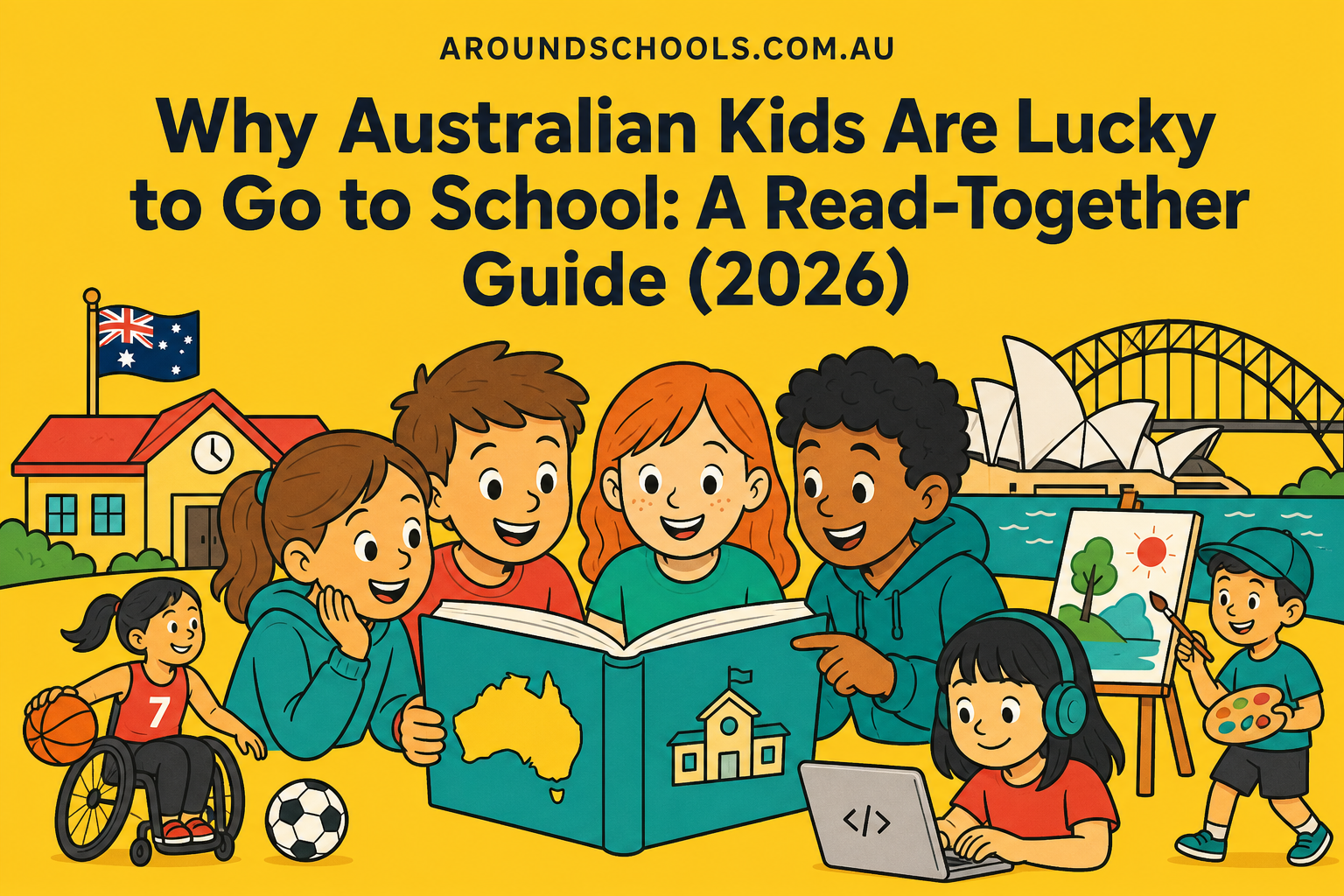
If you go to school in Australia, you are one of the lucky ones. Around the world, 273 million children and young people are not in school at all, according to UNESCO. That is about 65 times the number of students in every Australian school put together. In Australia the law says every child must go to school, and if you go to a government school, your lessons are free.
This guide is written for kids to read with a grown-up. The numbers are real and checked, and there are questions at the end to talk about together.
Key takeaways
- 273 million children and young people around the world are out of school (UNESCO GEM Report).
- 258 million children have their schooling disrupted by wars, disasters and other emergencies. 93 million of them can't go to school at all (Education Cannot Wait, June 2026).
- In Afghanistan, about 2.4 million girls are not allowed to go to high school (UNESCO, August 2026).
- In Australia, 4,160,918 students went to 9,673 schools in 2025, and about 6 in 10 were at government schools (ABS).
- Our own finding: half of Australia's primary schools have another primary school only about 1 km away. Three in four schools have at least one kids' activity (sport, art, coding and more) within 2 km.
What does "out of school" mean?
"Out of school" means a child who is old enough for school but doesn't go. There are lots of reasons, and none of them are the child's fault:
- There is no school nearby, or the walk is too long or unsafe.
- The family can't afford it. In some countries families must pay fees, buy books or pay for a uniform before a child can start.
- A war or disaster has damaged the school or made families leave home.
- Children have to work to help their family earn money.
- The rules stop them. In Afghanistan, girls have not been allowed to go to school after primary school since 2021. UNESCO says Afghanistan is the only country in the world where girls and women are banned from high school and university.
Here is a way to picture 2.4 million girls: it is more than half as many as all the students in every school in Australia.
Being in school isn't always enough, either. A 2022 report by the World Bank, UNESCO, UNICEF and partners found that 70% of 10-year-olds in low- and middle-income countries could not read and understand a simple story. Often that's because their classes are huge, there aren't enough teachers, or there are no books.
What Australian kids get that many children don't
School is the law, which means everyone gets a turn
In Australia, school isn't optional. In NSW, children must be enrolled by their 6th birthday, finish Year 10, and then stay in school, training or work until they are at least 17. In Victoria, school is compulsory from 6 to 17 unless a child has an exemption. Other states and territories have similar rules.
That might sound strict. But the rule is there to protect you: nobody can decide that you don't need to learn.
Lessons at government schools are free
The Victorian education department says government schools "must provide students with free access to instruction", and that any money a family gives the school is voluntary. Other states work the same way. Families still pay for some things, like uniforms, camps and excursions. The rules can also be different for some families who hold visas, so parents should check with their state's education department. But the teaching itself doesn't cost your family anything.
That's a big deal. In many countries, school fees are the main reason children stay home.
Lots of time to learn, every week
Queensland's school year has four terms of 10 weeks each. Victorian schools must give students at least 25 hours of lessons a week, and the school day usually runs from about 8:30 am to 3:30 pm. That's thousands of hours of learning by the time you finish school.
And most Australian students keep going: in 2025, 81.3% of students who started high school stayed until Year 12 (ABS).
A school just around the corner
This is something only AroundSchools can show you, because we map almost every school in the country. We looked at the 7,660 primary schools in our directory and measured how far each one is from the nearest other primary school:
- Half have another primary school within about 1 km. For most kids that is about a 15-minute walk.
- 71% have another one within 2 km.
- Only 291 (about 4%) have no other primary school within 30 km. Many of those are in country areas, where schools are far apart and some kids learn through distance education.
For many children in the world, the nearest school is a long walk away, or there isn't one at all. Most Australian kids could name more than one school they could walk to.
How we measured it: straight-line distance between school locations in the AroundSchools directory (September 2026). We counted schools that list primary year levels and ignored records sitting at the same spot, such as two campuses sharing one site.
Things to do after the bell
Learning doesn't stop at 3:30. Across the 9,358 active schools in our directory, 76% have at least one kids' activity within 2 km, and a typical school has 3. Looking at the kind of activity:
- 75% of schools have a sport option nearby.
- 22% have an academic one, like tutoring, coding or maths clubs.
- 19% have a creative arts one, like drawing, drama or dance.
You can see what's close to your own school on the AroundSchools activities page, or look at what's on this weekend with What's On. Our Kids' Activity Index shows which suburbs have the most going on.
How can kids help children who miss out?
Being lucky doesn't mean feeling guilty. It means noticing what you have and, if you want to, helping others get it too. Some ideas:
- Learn about one country. Pick a country on a map and find out what school is like there.
- Join or start a school fundraiser for a children's education charity. Ask your teacher which ones your school supports.
- Donate books or stationery you've finished with, through a school or local drive.
- Help a classmate. Some kids in your own class may be new to Australia, or may have missed school before they arrived. A friendly "want to sit with us?" matters.
- Show up. Going to school every day, even the boring days, is the easiest way to make the most of it.
Questions to talk about together
- What's one thing you learned at school this year that you're glad you know?
- If there were no school near us, how would you learn to read?
- Why do you think some countries don't let girls go to school? Is that fair?
- What would you miss most if you couldn't go to school?
- What's one way our family could help another child get to school?
Frequently asked questions
How many children in the world don't go to school?
UNESCO's Global Education Monitoring Report says 273 million children and young people are out of school worldwide. Education Cannot Wait's June 2026 report says 258 million children have their education affected by crises, and 93 million of those are completely out of school. These groups overlap, so the numbers shouldn't be added together.
Is school free in Australia?
Teaching at government schools is free. In Victoria, for example, schools must give students free access to lessons, and family contributions are voluntary. Families usually still pay for uniforms, camps and excursions. Catholic and independent schools charge fees, and rules can differ for some visa holders.
At what age do Australian kids have to go to school?
It depends on the state. In NSW, children must be in school by their 6th birthday, finish Year 10, and then stay in school, training or work until at least 17. In Victoria, schooling is compulsory from 6 to 17.
How many students are there in Australia?
The ABS counted 4,160,918 students in 9,673 schools in 2025. Of those students, 62.8% went to government schools, 20.0% to Catholic schools and 17.2% to independent schools.
Why are girls not allowed to go to school in Afghanistan?
Since 2021, Afghanistan's de facto authorities have barred girls from education beyond primary school, and women have been banned from university since December 2022. UNESCO estimates about 2.4 million girls are shut out of secondary school by 2026.
Related reading
- Public vs Catholic vs independent schools: how to choose
- NAPLAN results explained for parents
- What kids in NSW do outside school and in Victoria
- Activities for kids who don't like sport
Find a school near you on AroundSchools, or check which school zone you're in with the school catchment checker.
Figures correct as published by each source: UNESCO GEM Report (out-of-school estimate); Education Cannot Wait, "Breaking Barriers" (June 2026); UNESCO (14 August 2026); World Bank and partners, State of Global Learning Poverty (June 2022); ABS, Schools 2025 (released 5 March 2026); NSW and Victorian Department of Education and Queensland term-date pages (read 17 September 2026). AroundSchools directory figures measured 17 September 2026.