Free School Travel for Kids in Australia: What Every State Gives You (2026)
20 September 2026
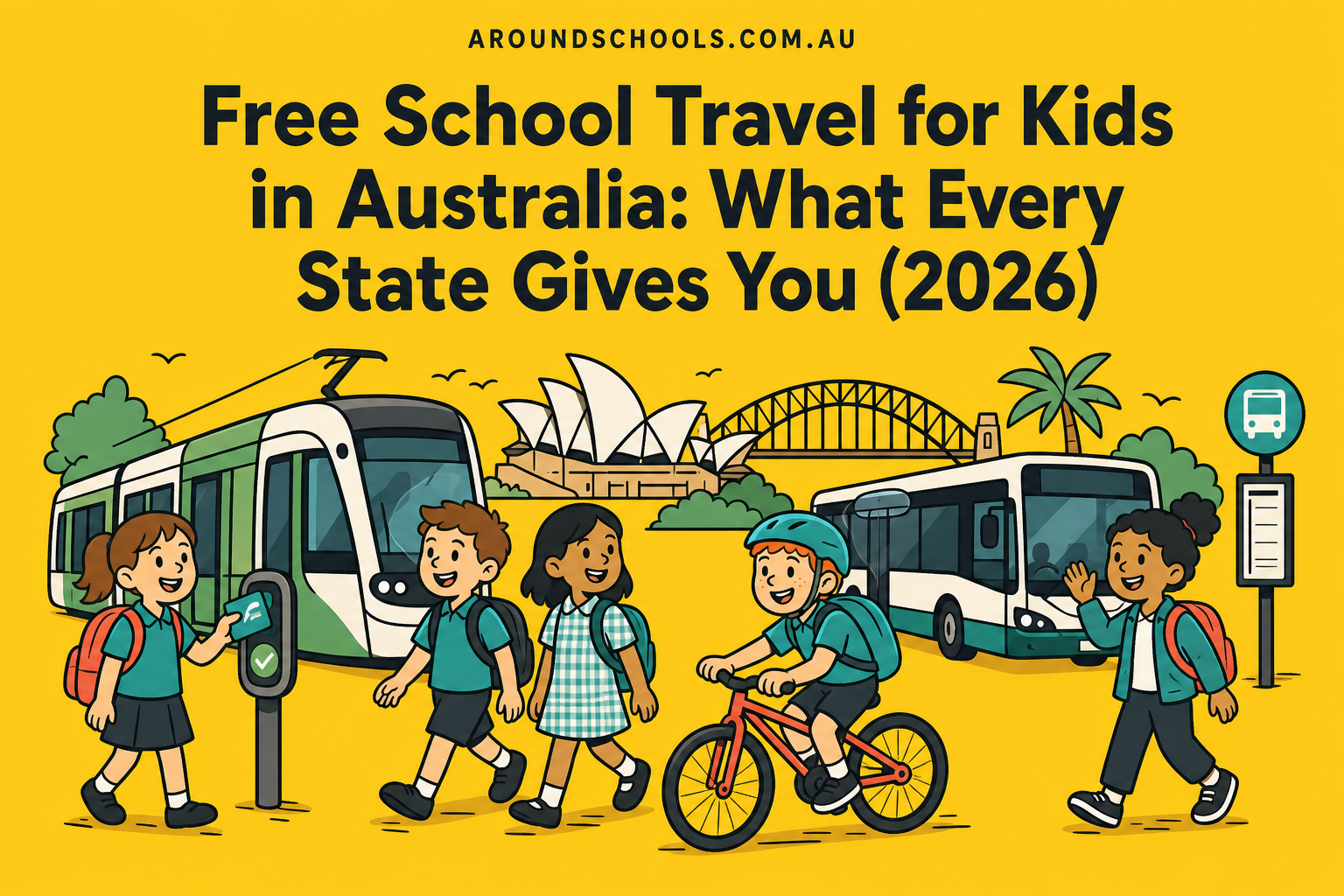
Whether your child travels to school for free depends heavily on where you live. In Victoria, everyone under 18 now rides public transport free, any day, anywhere — a saving of up to $755 a year per child. Tasmania's buses are free for everyone until mid-2027, and WA and the NT make the school run free for students. But in NSW and the ACT, free travel depends on how far you live from school, and in the ACT on holding a concession card too. And outside Victoria and Tasmania, weekend and holiday trips usually cost extra.
Checked on each state's own transport or education website in September 2026. Fares and rules change — confirm before you rely on them.
Key takeaways
- Victoria: free public transport for everyone under 18 since 1 January 2026 — every mode, every day, statewide. The government says it saves families up to $755 a year per child.
- Tasmania: all buses statewide are free for everyone, including fare-charging school buses, until 30 June 2027.
- Queensland: a 50 cent flat fare on every Translink zone and mode (except Airtrain), and children aged 5–14 ride free on weekends.
- Western Australia: students ride free Monday to Friday through the school year; Saturdays and the summer holidays are charged, and Sunday is free for everyone.
- NSW: free travel between home and school for eligible students — distance rules apply from Year 3, and applications for next year open at the start of Term 4.
- ACT: free school-term travel, but only for families holding a concession card and living more than 1 km (primary) or 2 km (secondary) from school.
State by state
Victoria — free for every child, every trip
Since 1 January 2026, public transport is free for everyone under 18 on trams, trains, buses and coaches, in metro, regional and rural Victoria. It isn't a school scheme: weekends, holidays and after-school sport are all covered. The Victorian Government puts the saving at up to $755 a year per child — the old price of a yearly student pass.
Families in rural and regional Victoria who drive their children because no free school bus runs may get the Conveyance Allowance if they live more than 4.8 km from the nearest appropriate school. For a private car it runs from $482 a year (4.8–10 km) to $1,207 a year (over 35 km), per the Department of Education's rates page.
Tasmania — free for everyone, for now
All bus services in Tasmania are free for every passenger — adults, concession holders, children and students, including government-contracted school buses that charge a fare. Metro Tasmania says it runs until 30 June 2027, after a 12-month extension in the May 2026 state budget. What happens after that date hasn't been announced, so budget for fares from July 2027.
Queensland — 50 cents a trip
Queensland's Translink fares are a flat 50 cents across all zones and modes: train, bus, ferry, tram and on-demand services (Airtrain excluded). Children aged 5 to 14 travel free on weekends with an orange child go card, and children 4 and under always travel free.
Families further from school can apply to the School Transport Assistance Scheme. The basic rule is that primary students live more than 3.2 km, and secondary students more than 4.8 km, from the nearest state school offering their level.
Western Australia — free on school weekdays
Under Ride to School Free, students with a Student SmartRider travel free on all Transperth services Monday to Friday, from the first to the last school day of the year. They must tag on and off every trip. Transperth charges a concession fare on Saturdays and during the summer school holidays. Its page doesn't spell out the shorter term breaks, so check before relying on them. Sundays are free for all passengers in WA.
The WA Government has made both permanent in its 2026–27 budget, and says Ride to School Free saves a two-child family up to $560 across the school year.
NSW — free if you live far enough away
The School Student Transport Scheme gives eligible students free travel between home and school on school days, on trains, buses, ferries and light rail. Transport for NSW's scheme factsheet sets the distance rules:
- Kindergarten to Year 2: any distance.
- Years 3–6: more than 1.6 km in a straight line, or 2.3 km or more by the most direct walking route.
- Years 7–12: more than 2 km in a straight line, or 2.9 km or more walking.
The pass covers the school run only: excursions, sport and weekend travel are charged at the normal child fare. Applications for next year open at the start of Term 4, so now is the time to apply for 2027. Transport for NSW also sells a School Term Bus Pass for $56 a term, valid between home and school on school days with one bus operator.
Note: the distance thresholds come from Transport for NSW's scheme factsheet. Its current web pages confirm the scheme but don't restate the distances, so check yours when you apply.
ACT — free, but only for concession families
The ACT's Student Transport Program gives free travel on Transport Canberra Monday to Friday during school term to students aged 5 to 19. The student or parent must hold a Pensioner Concession Card, Health Care Card or DVA Health Care card, and the student must live:
- more than 1 km from school (primary), or
- more than 2 km from school (high school, college or CIT).
Apply 4 to 6 weeks before the term begins. Other students pay student fares, which were $1.29 per trip on school days from January 2026.
Northern Territory
The NT Government's study site confirms free travel for NT primary, middle and senior high school students on buses. Check with the operator for the ID your child needs.
South Australia
South Australia offers discounted student passes on Adelaide Metro and free school buses for some country students. For current student fares and how to get a student pass, see adelaidemetro.com.au; for a country school bus, ask your school.
Why distance rules catch out most families
This is the part only our data can show. We measured how far each school in our directory sits from the nearest other school of the same level. That gap is a rough guide to how close families usually live to a school.
- In NSW, half of primary schools have another primary school within 0.92 km — well inside the 1.6 km line.
- For about two in three NSW primary schools, the next primary is closer than 1.6 km. The picture is similar in Queensland and the ACT.
The practical upshot: a family living near its local school usually won't qualify for the distance-based schemes. They mostly help children travelling further — to a school outside the local area, or in spread-out country areas. If your child goes to a school outside your neighbourhood, it is worth checking; you may qualify without realising it.
How we measured it: straight-line distance from each active school in the AroundSchools directory to the nearest other school with the same level (primary or secondary), September 2026. It measures school spacing, not any family's actual trip.
What to do now
- NSW: apply for 2027 School Student Transport Scheme travel once Term 4 starts, especially if your child is moving into Year 3 or Year 7, where the distance rule changes.
- ACT: if you hold a concession card, apply 4–6 weeks before Term 1.
- Victoria: there's nothing to apply for; check Public Transport Victoria's site for the card your child should carry.
- WA: make sure your child has a Student SmartRider and tags on and off; from 1 March a card is required to travel free.
- Country families in VIC or QLD: check the conveyance allowance or School Transport Assistance Scheme if there's no free bus.
Checking your school's zone? Our school catchment checker shows which government school zones cover your address, and you can find schools near you.
Frequently asked questions
Is public transport free for kids in Australia?
It depends on the state. Victoria makes it free for everyone under 18, and Tasmania's buses are free for everyone until 30 June 2027. Elsewhere it's free for the school run if your child is eligible, or cheap (50 cents a trip in Queensland).
How far do you have to live from school for free travel in NSW?
Kindergarten to Year 2 students qualify at any distance. Years 3–6 need to live more than 1.6 km in a straight line (or 2.3 km walking), and Years 7–12 more than 2 km (or 2.9 km walking).
Does free school travel cover weekends and holidays?
Only in Victoria and Tasmania. NSW and ACT schemes cover home-to-school trips on school days. WA charges on Saturdays and in the summer holidays, but Sunday is free for everyone.
When do I apply for free school travel in NSW?
Applications for the next school year open at the start of Term 4.
Who gets free school travel in the ACT?
Students aged 5 to 19 whose family holds a Pensioner Concession Card, Health Care Card or DVA Health Care card, living more than 1 km (primary) or 2 km (secondary) from school. It covers weekdays during school term.
Related reading
- Help with school costs in every state
- Why Australian kids are lucky to go to school
- The real cost of kids' sport in Australia
Sources: Premier of Victoria (18 May 2025); Victorian Department of Education, Conveyance Allowance rates (updated 3 February 2026); Metro Tasmania (21 May 2026); Translink; Transperth and WA Government media statement (19 April 2026); Transport for NSW; Transport Canberra; Study NT. All read 18–19 September 2026.