School Zone Times in Australia: Which Days the Limit Actually Applies
25 September 2026
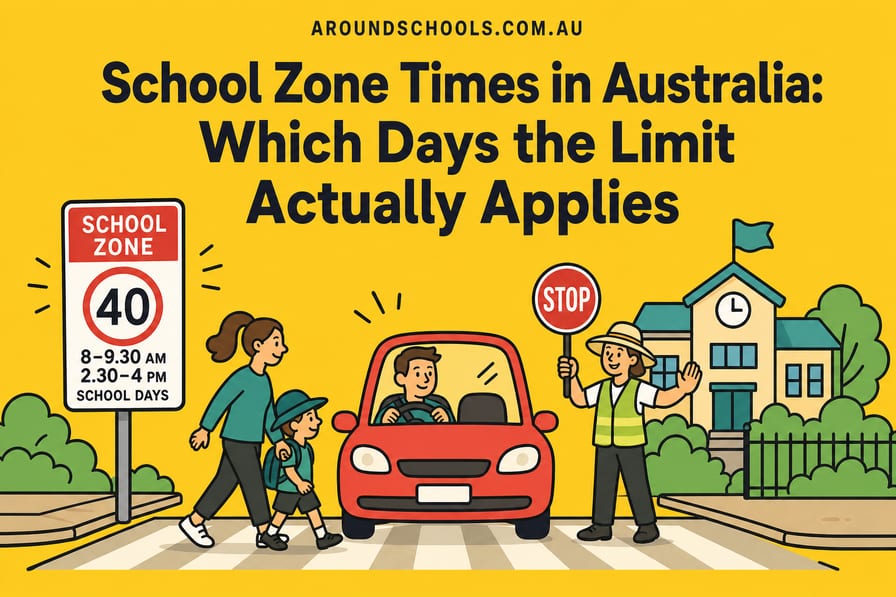
School zones switch back on between Monday 5 October and Monday 19 October 2026, and which date applies to you depends on the state you drive in. The speed limit and the hours are printed on the sign. What the sign cannot tell you is whether today counts as a school day — and that is decided by your state education department's term calendar, not by whether you can see any children.
That is the part parents get wrong, and it is the part that costs money.
Key takeaways
- Most states tie the zone to the school term calendar, not to the school gate — but not all. South Australia's school zones apply 24 hours a day all year, and Queensland tells drivers to read the sign, because schools sharing one zone can have different term dates.
- Two full weeks separate the first state and the last this spring. Victorian zones are live again on Monday 5 October 2026; Tasmanian zones not until Monday 19 October.
- In New South Wales and the ACT, pupil-free days count. Both include staff development days as operating days, so the zone can be live the day before students go back.
- The limit is not always 40. Victoria signs 30, 40 and 60 km/h by road type; Queensland uses 60 where the normal limit is 80 or above; South Australia drops to 25 whenever a child is present.
- Read the sign for the speed and the hours; read the calendar for the day. The two halves of the answer come from different places.
When do school zones switch back on after these holidays?
Term 4 2026 begins on five different dates. These are the government-school student return dates published by each state education department, and they are the dates the road rules point to.
| Zones live again | States and territories | Schools affected |
|---|---|---|
| Monday 5 October 2026 | Victoria | 2,244 |
| Tuesday 6 October 2026 | Queensland, Northern Territory | 1,926 |
| Monday 12 October 2026 | Western Australia, South Australia | 1,735 |
| Tuesday 13 October 2026 | New South Wales, ACT | 3,194 |
| Monday 19 October 2026 | Tasmania | 259 |
School counts are the operating schools in the AroundSchools directory in each state, read on 26 September 2026.
One state never left. Tasmanian government schools are still in Term 3 until Friday 2 October 2026, so Tasmanian school zones have been operating on weekdays right through the fortnight the mainland spent on holidays.
Why does the calendar decide, and not the children?
Because the road authorities say so, in those words. Transport for NSW states that 40km/h school zones "are in force on all notified school days" and that these "exclude weekends, public holidays and public school holidays".
South Australia's Department for Infrastructure and Transport is even more direct about where the dates come from: its new 40 km/h time-based limit applies on school days, and "School days are defined by the Department for Education".
Victoria ties its zones to the term calendar the same way — time-based zones there "operate on weekdays during Victorian school terms".
A school zone does not know whether your child's school has students in it today. It knows what the term calendar says.
Does the zone still apply on a pupil-free day?
In New South Wales, yes — and it is the rule most likely to catch a careful driver out. Transport for NSW is explicit: "40km/h school zone days include school development days (or pupil-free days), as some students may still attend school on these days."
Term 4 2026 makes the trap concrete. NSW students return on Tuesday 13 October, but Monday 12 October is a school development day — so NSW school zones are already live on the Monday, with an empty playground and a full 40km/h limit.
If your state publishes its pupil-free days, treat them as operating days unless the road authority says otherwise. An empty car park is not evidence that the zone is off.
What speed applies, and at what times?
The sign in front of you is the authority — it carries both the number and the hours, and they vary far more between states than most drivers expect.
| State | What the sign can say | Hours | Which days |
|---|---|---|---|
| New South Wales | 40 km/h; 30 km/h inside a High Pedestrian Activity Area | 8–9.30am and 2.30–4pm for most zones | Notified school days, including pupil-free days |
| Victoria | 30, 40 or 60 km/h by road type | 8–9.30am and 2.30–4pm | Weekdays during Victorian terms; not public holidays |
| Queensland | 40 km/h where the normal limit is 50–70; 60 km/h where it is 80 or above | Usually 7–9am and 2–4pm; split-campus zones can run 7am–4pm | Read the sign — schools sharing a zone can have different terms |
| Western Australia | 40 km/h | 7.30–9am and 2.30–4pm, with regional variations | School days, unless the sign says otherwise |
| South Australia | 25 km/h whenever a child is present; separate 40 km/h zones | The 40 km/h zones 8–9.30am and 2–4pm | The 25 km/h zone applies 24 hours a day, all year |
| Tasmania | 40 km/h | Each school sets its own — read the sign | Monday to Friday in term; not holidays, weekends or public holidays |
| ACT | 40 km/h | Typically 8am–4pm, one continuous window | All gazetted school days, including pupil-free days |
| Northern Territory | 40 km/h or less | Signs typically read 7am–5pm; the sign is what binds | School days |
Three rows are worth a second look.
South Australia is the real exception. Its road-safety agency states that in South Australia school zones apply 24 hours a day, 7 days a week throughout the year. The zone never switches off; what switches is the trigger — 25 km/h applies whenever a child is in the zone, and a child there means anyone under 18, or a student of any age in school uniform. Separate 40 km/h time-of-day limits run at drop-off and pick-up, and the afternoon one starts at 2pm, not 2.30pm.
The ACT is the only jurisdiction with a single continuous window, typically 8am to 4pm, with no midday break. It is also the second place that spells out the pupil-free rule: a 40km/h school zone there operates on all gazetted school days including staff development days. ACT signs physically fold open and shut — folded up in the holidays, folded down when the zone is live — so if you see one folded down, it applies.
Tasmania has no statewide hours at all. Its transport department says each school sets its own times for its electronic signs, so the zone hours genuinely differ from one school to the next. What is fixed there is the days: Monday to Friday in term, and not on school holidays, weekends or public holidays.
The Northern Territory is the longest day of all. NT road safety tells drivers to stick to 40 in school zones from 7am to 5pm every school day, and the school zone sign in the NT Road Users' Handbook carries those hours printed on its face. The law itself sets no clock times there — as everywhere, the sign is what binds.
Queensland deliberately does not publish a days rule. Its advice is that if you are unsure whether it is a school day, you should slow down to the speed limit displayed on the school zone sign — because more than one school can share a zone and each can have different term dates.
Some zones are permanent rather than time-based, in Victoria and elsewhere. A permanent zone applies at all times whatever the calendar says, so the hours above only govern signs that show hours.
What does getting it wrong cost?
In most of Australia a school zone changes the speed limit but not the penalty. Two places price the zone itself — New South Wales and the ACT — and New South Wales does it far harder. On its lowest band NSW charges $246 and 2 demerit points against $149 and 1 point for the same speed outside a zone, a 65 per cent loading. The ACT's equivalent step is $423 against $394, about 7 per cent.
| State | Lowest band | Fine | Demerit points | Priced differently in a school zone |
|---|---|---|---|---|
| Western Australia | 9 km/h or less over | $100 | 0 | No |
| New South Wales | 10 km/h or under, in a school zone | $246 | 2 | Yes |
| Victoria | Less than 10 km/h over | $261 | 1 | No |
| Queensland | Less than 11 km/h over | $345 | 1 | No |
| ACT | 15 km/h or under, in a school zone | $423 | 1 | Yes |
Bands are not identical between states, so read each row as that state's own lowest step. Figures are the published schedules: New South Wales as at 1 July 2025, Victoria and Queensland from 1 July 2026, Western Australia as published on 24 July 2026, the ACT effective 1 August 2026. South Australia, Tasmania and the Northern Territory set their own schedules, and Tasmania states its penalties in penalty units rather than dollars — check yours before relying on a number.
Two more things worth knowing. In New South Wales a double demerit period doubles the points, not the fine, and some double demerit days fall on school days. And this is not a rare mistake: Transport for NSW recorded more than 183,000 school zone speeding offences in New South Wales in the last financial year, nearly 70 per cent of them during active school zone hours.
The safer habit is cheaper than any of these. If you are passing a school on a weekday in term, assume the zone is live.
How do I check the dates for my own school?
Start with your state's term dates, then confirm with your school. Independent and Catholic schools can begin and end a term a few days either side of the government dates, and a school in the middle of its own pupil-free day still sits inside a live zone if the state calendar says term has started.
We keep the government dates for every state current on our school holiday pages, refreshed twice a day:
- School holidays in Victoria
- School holidays in New South Wales
- School holidays in Queensland
- School holidays in Western Australia
- School holidays in South Australia
- School holidays in Tasmania
- School holidays in the ACT
- School holidays in the Northern Territory
If you have just moved and are working out which school your address is zoned for — a different meaning of the phrase entirely — our school catchment checker answers that one.
Frequently asked questions
Do school zones apply during the school holidays?
No, other than where a state signs a permanent zone that applies at all times. Time-based zones operate on school days, which exclude weekends, public holidays and school holidays.
Do school zones apply on a pupil-free day?
In New South Wales and the ACT they do — both count staff development days as operating days. The other states do not say either way, so check your road authority and assume the zone is live unless it says otherwise.
Are school zone times the same in every state?
No. The windows differ between states, the ACT runs one continuous 8am–4pm period instead of a morning and afternoon split, and the speed is not always 40 km/h. The times that bind you are the ones printed on the sign in front of you.
My state is on holidays but I am driving interstate — whose calendar applies?
The calendar of the state you are driving in. Term dates differ by up to two weeks, so a family driving from Melbourne to Sydney in the second week of October crosses from a state whose zones are live into one whose zones are not yet.
Does the limit apply if there are no children around?
Yes. South Australia is the one place where a child being present is the trigger, and there the zone runs all year rather than only in term. Everywhere else a time-based zone applies for its full signed period whether or not anyone is walking past.
How we checked
Term dates for all eight states and territories come from each state education department's published calendars, held by AroundSchools and last verified against those calendars on 25 September 2026. As a cross-check, Transport for NSW publishes its own list of notified school days: its Term 3 and Term 4 2026 dates for New South Wales match ours exactly.
Rules were read at government sources on 26 September 2026: Transport for NSW, Queensland Government, the WA Road Safety Commission and Main Roads WA, the Tasmanian Road Rules, and ACT City Services. Victorian, South Australian and Northern Territory road-authority sites decline automated requests, so those rules come from archived copies of the same government pages, captured January 2026, November 2025 and July 2026 respectively. Penalty figures come from each state's own published schedule. School counts are the operating schools in the AroundSchools directory on 26 September 2026.
One piece of context is survey research rather than government data: AAMI's January 2026 back-to-school release reports that more than a third of Australian drivers are baffled by school zones, from a national survey of 1,000 people.
Rules change. Before you rely on a figure here, check the sign in front of you and your own state's road authority.