Aussie Hoops: What Age, What It Costs and When Your Child Is Ready for a Club
24 September 2026
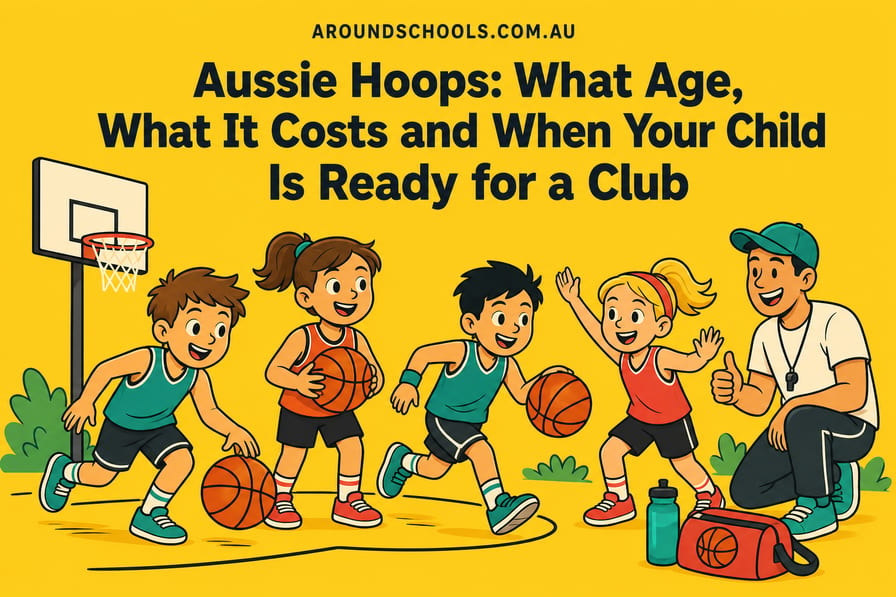
Ford Aussie Hoops is Basketball Australia's entry program for children aged 5 to 10. Sessions run weekly "for between 45 and 75 minutes" and a program runs "for between 5 and 10 weeks". There is no national price — Basketball Australia says plainly that "each Local Centre sets their own price point", and published centre prices we checked ranged from $55 to $115 a program.
The question parents actually ask is when to move up to a real club team. Basketball Australia is unusual in refusing to answer it with a number: "There is not a 'one size fits all' approach for when your child is ready to join a club, or a specific age determining when your child is ready." It publishes a readiness checklist instead, and that checklist is more useful than any age.
Key takeaways
- Ages 5 to 10, in three stages — Rookie (5-6), Starter (7-8) and All-Star (9-10) — though local centres re-cut those bands to suit their own groups.
- No national price. Each centre sets its own. Two centres we checked charged $55 and $115 for a program.
- Check what is stacked on top. One centre's $55 headline became $117.94 once the state registration fee and the participant pack were added. Ask for the all-in number.
- The pack is an optional extra, not part of the fee — unlike cricket, where it is included.
- No age for joining a club. Basketball Australia says a "very confident six year old may find themselves ready… before a less confident ten year old", and gives five readiness signals.
- You do not need to reach a 10-foot ring. Basketball Australia calls that "nice to have, but by no means essential".
- Basketball is growing fast — 45,886 Aussie Hoops participants in 2025, up 7.3%, and about 350,000 regular junior participants nationally.
What age can my child start basketball?
Five. Basketball Australia describes Ford Aussie Hoops as "the premier destination for basketball enthusiasts aged 5-10 in Australia", and its coaching guide splits that into three stages: Rookie for "5 and 6 year olds", Starter for "7 and 8 year olds" and All-Star for "9 and 10 year olds". The stages exist so that "for each age group, participants are participating in activities and games that are relevant to their physical and mental capabilities".
One caveat worth carrying into a phone call: local centres re-cut those ages freely. Looking at centres advertising for Term 4 2026, we found groups running as 4-6, 7-9 and a separate 4-9 girls' session — none of which matches the national three-stage split. The stage names are a national framework; the groups your centre actually runs are a local decision. Ask which groups exist near you rather than which stage your child is "in".
What does Aussie Hoops cost?
There is no answer to this nationally, and Basketball Australia says so: "Each Local Centre sets their own price point. These can be found on the Program Locator tool."
That makes the two published centre prices we read worth more than an average would be:
| Centre | Program price | Sessions | Session length | Per session |
|---|---|---|---|---|
| A Western Australian centre, Term 4 2026 | $115.00 plus a 1.99% transaction fee | 7 | 45 minutes | $16.43 |
| A Queensland centre, Term 4 2026 | $55.00 | 5 | 60 minutes | $11.00 |
Those per-session figures are our arithmetic, not the centres'. But the second row is the one to learn from, because the $55 is not what that family pays. The same page adds "Plus BQ $12.94 registration & BA $50 Participant packs if required" — so the real first-year cost runs to $117.94, or $23.59 a session. The headline was less than half of it.
So the question to ask a centre is not "how much is the program" but "what will I pay in total the first time". Basketball is not alone in stacking a state registration fee under the program fee, but it is unusually easy to miss here because the program price is set locally and the other two are not.
The participant pack is genuinely optional. Basketball Australia lists three tiers — a Core Pack with a "Size 4 or 5 Spalding Basketball", a "Personalised Reversible Singlet" and a sticker sheet; a Lifestyle Pack adding a drawstring bag; and a Premium Pack adding a backpack. It publishes no price for any of them, and packs are dispatched within 3 to 5 business days of registration, arriving in 7 to 10. If money is tight, the singlet is the only part your child will notice at a session.
Which voucher pays for it
Every state and territory except the ACT runs a kids' sport voucher, and PlayHQ — the platform Aussie Hoops registers through — supports all of them. Each figure below was read on its own government page on 24 September 2026:
- Western Australia — KidSport: up to $500 per financial year, ages 5 to 18, Health Care Card or Pensioner Concession Card. Open year round; each voucher valid 90 days.
- Victoria — Get Active Kids: up to $200. Round 11 closes at 10am on 13 October 2026, or earlier if the budget runs out.
- Queensland — Play On!: up to $200, ages 5 to 17, one per financial year. Open until 18 December 2026, present by 18 June 2027.
- South Australia — Sports Vouchers: two of $100 per calendar year, and from 1 January 2027 eligibility widens to all children aged 5 to 18.
- Tasmania — Ticket to Play: two vouchers of up to $100, ages 5 to 18, open 6 July 2026 to 28 May 2027.
- Northern Territory — Sport Voucher Scheme: two $100 vouchers a year for every enrolled and home-schooled child from transition to Year 12. Rounds open around July and January — check sportvoucher.nt.gov.au for this round's dates.
- New South Wales — Active and Creative Kids: $50 twice a year, ages 4.5 to 18, for families receiving Family Tax Benefit.
- Australian Capital Territory: no sport voucher. Use the Future of Education Equity Fund — $400 preschool, $500 primary, $750 high school and college — which covers "sporting activities". Applications close 27 November 2026.
Basketball is the one sport in this series where you are not necessarily too late if you have already paid. Basketball Victoria states both routes explicitly: if you have not registered, get the voucher and "present your voucher at the checkout on PlayHQ"; if you have already paid, there is a "Get Reimbursed" path. That is unusual — Netball Queensland, by contrast, treats applying a voucher to a completed registration as a breach of its terms. Getting the code first is still the safe habit, but Victorian basketball families who have already paid should check before assuming the money is gone.
One trap in the fine print: "If a participant uses a voucher to register, they will unfortunately not be issued a refund." A voucher-paid registration is not refundable, so be sure of the day and time before you use one.
When is my child ready for a club?
This is where Basketball Australia says something genuinely useful, and it is worth quoting at length because almost every article on this subject answers with an age:
"There is not a 'one size fits all' approach for when your child is ready to join a club, or a specific age determining when your child is ready. A very confident six year old may find themselves ready to transition from Ford Aussie Hoops into a local competition before a less confident ten year old."
Instead it publishes five signals. Your child is likely ready when they:
- display confidence in more competitive Aussie Hoops activities "that involves some type of pressure"
- understand the basic rules — "no running with the basketball and no hitting/grabbing players"
- dribble one-handed confidently
- can catch and pass the ball
- display "cooperation and willingness to share with teammates during activities"
Read that list again and notice what is not on it: height, shooting, or being able to score. Basketball Australia addresses that directly — "Being able to shoot on a 10-foot basketball ring is nice to have, but by no means essential – as your child grows they will develop the strength to score baskets on whichever ring size your competition uses." If your child is hanging back from club basketball because they cannot reach the ring, that is the sentence to show them.
Club basketball itself is an "age-based competition (e.g. Under 8s, Under 10s)", and the details are local: Basketball Australia notes that "each club competition varies in terms of timing, age groups, travel and uniform requirements" and points you to your Local Centre Coordinator for the specifics.
When do programs run?
All year. Basketball Australia says programs run "all year round" and are "typically in conjunction with the applicable school terms in your State or Territory" — so a new block starts near the beginning of each school term, four times a year, with the centre choosing its own length within the 5 to 10 week band.
Because school terms start up to a fortnight apart across the country, that means there is no national start week. Term 4 2026 begins Monday 5 October in Victoria, Tuesday 6 October in Queensland, Monday 12 October in Western Australia and South Australia, Tuesday 13 October in New South Wales and the ACT, and Monday 19 October in Tasmania — the government student attendance dates we publish on our school holidays pages. The Term 4 centre programs we checked started on 19 October and 31 October respectively, so centres do drift past the first week of term.
Registration is online only and Basketball Australia says it "should take no longer than 5 minutes". One date to note: refunds require written notice to your centre at least 10 days before the program starts, which is tied to the program date, not the school term.
How big is junior basketball now?
Bigger than most parents assume, and growing. Basketball Australia reported 45,886 participants in Ford Aussie Hoops in 2025, a 7.3% rise on 2024, delivered through 2,649 programs at 267 centres, with 21,460 of those children new to basketball. Nationally it describes "over 350,000 regular junior participants" and "approximately 1.3 million players nationwide", with participation among girls and women up 25% since 2022.
The state split is the surprise. In 2024, Victoria alone accounted for 18,379 of 42,819 national participants — 43% of them, and more than double New South Wales at 8,255. Western Australia ran 7,759, ahead of Queensland's 3,342. If you are in Melbourne, a centre is probably close. In Brisbane or Darwin, start with the locator rather than assuming.
The gender split is shifting too, from 72% male and 28% female in 2024 to "nearly 30%" female by Term 2 2026. Basketball Australia's dedicated girls' program, She Hoops, ran holiday camps across six states and territories engaging "close to 1,300 girls", and received a federal grant of nearly $1 million in 2024 to launch its Play Our Way program.
One honest counterweight to all that growth: Basketball Australia has cited a Basketball NSW finding that "up to 150,000 players are missing out each year due to a lack of court space". If your local centre's program fills within hours, that is why — and it is an argument for registering the week it opens rather than the week it starts.
Finding a centre near you
The authoritative list is Basketball Australia's own Program Locator at aussiehoops.basketball, which is the tool centres keep current and the only place the local price appears.
We do not list many basketball clubs ourselves, and the reason is worth knowing because it applies across junior sport: our directory holds 1,549 tennis programs and 1,543 swim schools but only a handful of basketball, cricket and netball clubs. Tennis and swimming are taught by commercial businesses that market themselves online; basketball associations are largely volunteer-run and do not. That is a fact about who does the advertising, not about how much basketball is played near you.
One we do list is Easts Basketball League in Sydney. To see the whole mix of what runs near you in the same week, browse your suburb on kids' activities — for example Sydney — or the national picture in our Kids' Activity Index.
Frequently asked questions
What age can a child start basketball in Australia?
Five. Ford Aussie Hoops is published for ages 5 to 10, in three stages: Rookie (5-6), Starter (7-8) and All-Star (9-10). Local centres often run different age groupings.
How much does Aussie Hoops cost?
There is no national price — Basketball Australia says each local centre sets its own. Two centres we checked charged $55 and $115 for a program. Ask for the all-in figure, because a state registration fee and the participant pack can sit on top.
Is the participant pack included?
No. It is an optional purchase in three tiers, and Basketball Australia publishes no price for it. One centre described the pack as a $50 add-on.
What age do kids join a basketball club?
Basketball Australia deliberately does not publish one, saying there is no "specific age determining when your child is ready". It lists five readiness signals instead — confidence under pressure, knowing the basic rules, dribbling one-handed, catching and passing, and cooperating with teammates.
Does my child need to shoot on a full-height ring first?
No. Basketball Australia says that is "nice to have, but by no means essential", because children develop the strength as they grow.
Can I use a government sports voucher for basketball?
Yes, everywhere except the ACT. Registration runs through PlayHQ, which supports every state scheme. Victoria uniquely publishes both a before-you-pay and a reimbursement route. Note that a voucher-paid registration is not refundable.
When do Aussie Hoops programs run?
All year round, usually aligned to school terms, with each centre setting a program length between 5 and 10 weeks.
How we checked
Ages, session and program lengths, the pricing statement, the participant packs, the club-readiness guidance and the refund rules were read on Basketball Australia's own Ford Aussie Hoops parent pages at aussiehoops.basketball on 24 September 2026. Note the program's site is aussiehoops.basketball — the .com.au address did not resolve when we checked.
The three stage names and their ages come from Basketball Australia's local centre coaching guide, which is served from a host that blocks automated requests, so it was read through a reader proxy. We have flagged in the article that centres advertise different age groupings, because they do.
Participation figures for 2025 are from Basketball Australia's own report of the year, published 20 January 2026. The state-by-state and gender splits are from its 2024 annual report, page 22, read directly — the 2025 annual report would not open for us, so the state numbers are dated 2024 rather than presented as current. The junior and national totals come from Basketball Australia's June 2025 article citing AusPlay. Per-session costs are our arithmetic on published centre prices and session counts.
Voucher amounts, eligibility and dates come from each government's own program page, read the same day; the Northern Territory scheme's page still showed a 2021 round, so we have given its value and eligibility but no round dates. School term dates are the government student attendance dates on our school holidays pages. Prices and voucher rounds change — check both before you pay.