Tennis Hot Shots: What Age, What It Costs and How the Stages Actually Work
24 September 2026
Your child can start Swisse Hot Shots Tennis at three, and the first stage does not use a tennis court at all — Tennis Australia describes the Blue stage as "a large, flat and safe area". A term costs $120 to $300 on Tennis Australia's own published average, across an 8 to 10 week term of 30 to 60 minute sessions. That works out at roughly $12 to $37.50 a session, which is our arithmetic on their two published ranges, not a figure they print.
There is no national start date to wait for. Unlike footy or cricket, Hot Shots has no season — the term dates and the price are both set by your local coach, which is why Tennis Australia's own page ends with "Check with your coach for the final price".
Key takeaways
- Start age: three. Blue stage is 3-5+, and it is movement skills on an open space, not tennis on a court.
- Cost: $120 to $300 per term, Tennis Australia's published average "for an 8-10 week term". No national fixed price exists.
- Per session: about $12 to $37.50, derived from those two ranges. The gap between the ends is nearly threefold, so it is worth ringing two venues.
- The court grows nearly eightfold as your child moves up, from 24.7 square metres to a full 195.6 square metre court.
- The ball changes before the court does — 25% compression at Red, 50% at Orange, 75% at Green. A softer, slower ball is what makes a rally possible at five.
- Vouchers apply. Tennis Australia says states offer "sometimes up to $500 per child or family", and tennis clubs list Hot Shots classes as voucher-eligible by stage.
- Tennis is the most listed kids' sport in our directory — 1,549 programs across 1,089 suburbs, just ahead of swimming.
What age can my child start tennis?
Three — but read what the first stage actually is before you picture a court.
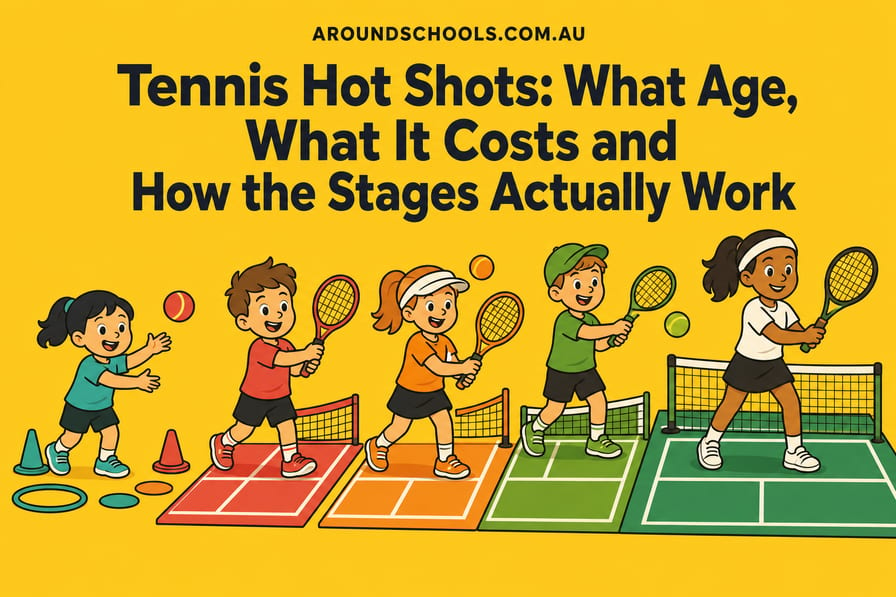
Tennis Australia's Blue stage covers ages 3-5+ and its own description is "a large, flat and safe area that provides children of this age and stage to engage in a variety of foundational Fundamental Perceptual Movement Skills using colourful and interesting equipment designed to stimulate movement". That is throwing, catching, balancing and tracking a ball. The recommended racquet is 17 or 19 inches, roughly forearm length.
From there the stages are Red (5-8+), Orange (8-10+) and Green (10+). Every range carries a plus sign, and that is deliberate: a child moves up when they are ready, not on a birthday. The ranges also overlap, so a five-year-old legitimately sits in either Blue or Red and an eight-year-old in either Red or Orange. If you are choosing between two, the honest tiebreaker is whether your child can already rally a few shots — that is the skill Red is built around and Blue is not.
Each stage is subdivided again, which most parents never hear about. Tennis Australia splits Red into Red 1, Red 2 and Red 3, because these "acknowledge the different rates of development realised between this general age range", and splits Orange into Orange 1 and Orange 2 and Green into Green 1 and Green 2. So "Red" is not one thing — ask your coach which Red your child is in, and you will get a much more useful answer about what they are working on.
Why the court and the ball keep changing
This is the part that makes tennis work for small children, and it is the thing a parent watching from the fence usually misses.
A Red 1 court is 3m by 8.23m. A full court is 8.23m by 23.77m. In playing area that is 24.7 square metres growing to 195.6 — nearly eight times bigger. No five-year-old can cover a full court, so tennis shrinks the court instead of asking the child to grow into it.
The net comes down too, and then back up: 75 cm through Red and Orange 1, 65 cm at Orange 2 and Green 1, then full height at Green 2.
The ball is the other half, and it changes on a different schedule from the court:
| Stage | Ball | Court | Racquet |
|---|---|---|---|
| Blue | Red ball, 25% compression | No court, open space | 17 to 19 inch |
| Red | 25% compression, larger diameter than a yellow ball | 3m x 8.23m up to 5.5m x 10.97m | 19, 21 or 23 inch |
| Orange | 50% compression, full diameter | 5.5m x 13m up to 6.4m x 18.29m | 23 to 25 inch |
| Green | 75% compression, full diameter | 7m x 20m up to full court | 25 to 27 inch |
A 25% compression ball bounces low and slowly, which buys a small child the extra half-second they need to get a racquet on it. By Green the ball is at 75% and behaving almost like a yellow ball. If your child is being handed a full-pressure yellow ball at seven, something is wrong — that is a fair question to ask a coach.
What does Hot Shots actually cost?
Tennis Australia publishes an average rather than a price: "$120-300 per term", described as "On average for an 8-10 week term", with the caveat "Check with your coach for the final price". Sessions "typically" run 30 to 60 minutes.
Put those together and the published envelope per session is:
| Cheapest end | Dearest end | |
|---|---|---|
| Term price | $120 | $300 |
| Term length | 10 weeks | 8 weeks |
| Per session | $12.00 | $37.50 |
That arithmetic is ours, not Tennis Australia's — they publish the ranges, not the division. But it is the number that lets you compare a term of tennis against a term of swimming or a season of footy, and the spread is the real finding: the dear end is more than three times the cheap end for the same official program. Two venues ten minutes apart can sit at opposite ends of it. Ring both.
Which voucher pays for it
Tennis Australia states that "Many states and territories offer vouchers to help with sport costs — sometimes up to $500 per child or family", and club pages are specific that Hot Shots qualifies: one Queensland club's voucher page lists eligible activities as "Tennis Hot Shots Classes (Red, Orange, Green, Blue Stages)" and "Junior Group Programs".
Each figure below was read at its own government page on 24 September 2026:
- Western Australia — KidSport. Up to $500 per financial year, ages 5 to 18, for children named on a Health Care Card or Pensioner Concession Card. Open year round; each voucher valid 90 days. Covers "registration, membership or participation fees".
- Victoria — Get Active Kids. Up to $200 per child. Round 11 closes at 10am on 13 October 2026, or earlier if the budget runs out. Covers "membership and registration fees".
- Queensland — Play On! Sports Vouchers. Up to $200, ages 5 to 17, one per financial year. Open until 18 December 2026; present the voucher by 18 June 2027. This replaced FairPlay.
- South Australia — Sports Vouchers. Two of $100 per calendar year, and one Adelaide tennis club's own page confirms "your membership fee will be reduced by $100.00". From 1 January 2027 eligibility widens to all children aged 5 to 18.
- Tasmania — Ticket to Play. Two vouchers of up to $100, ages 5 to 18, for children on a health care or pensioner concession card or in out-of-home care. Open 6 July 2026 to 28 May 2027.
- Northern Territory — Sport Voucher Scheme. Two $100 vouchers a year, transition to Year 12, and Tennis NT states they "can be used for your kid's tennis lessons, including group programs and coaching". Rounds open around July and January — check sportvoucher.nt.gov.au for this round's dates.
- New South Wales — Active and Creative Kids. $50, twice a year, ages 4.5 to 18, for families receiving Family Tax Benefit. Two unexpired vouchers can be combined.
- Australian Capital Territory. No sport voucher here. ACT families should apply to the Future of Education Equity Fund — $400 preschool, $500 primary, $750 high school and college — which lists "sporting activities" among its covered costs. Applications close 27 November 2026.
At the $120 floor a voucher covers a full term everywhere except New South Wales and the ACT, and in Western Australia it covers four terms.
Get the voucher code before you book, not after. Tennis club pages put it as "present or email it to us when registering" and "use the voucher before its expiry date", which is a timing instruction rather than a hard bar on applying one later. Other sports are stricter: netball's Queensland body states plainly that applying a voucher to an already-completed registration breaches its terms. Treat "before you pay" as the safe rule across every sport.
When does it start? There is no national date
This is where tennis differs from every other sport in this series, and it is good news.
Footy, cricket and netball all have a season, so missing the registration window means waiting a year. Hot Shots does not. Programs are run by individual coaches and venues, sessions are "delivered during school terms", and each venue sets its own term length within that 8 to 10 week band. Tennis Australia publishes no national Hot Shots calendar, and there is no 2027 date to wait for.
In practice that means a term starts near the start of every school term, four times a year, and your local venue decides the exact week. Because term start dates vary by up to a fortnight across the country, here is when each state's students actually go back:
| State or territory | First day of Term 4 2026 |
|---|---|
| Victoria | Monday 5 October |
| Queensland | Tuesday 6 October |
| Western Australia | Monday 12 October |
| South Australia | Monday 12 October |
| New South Wales | Tuesday 13 October |
| Australian Capital Territory | Tuesday 13 October |
| Tasmania | Monday 19 October |
Those are the government student attendance dates we publish on our school holidays pages. Independent and Catholic schools drift by a few days — and since your tennis venue is not a school, ring it rather than assuming it follows your child's calendar.
Hot Shots, Match Play, or real competition?
Once a child can rally, the question becomes whether they want to compete.
Hot Shots Match Play is the first step, and it is built to be gentle: Tennis West describes "Orange Ball Match Play (7 - 10 years old)" and "Green Ball Match Play (9 - 11 years old)", with a "shortened match format first to four games so children have the opportunity to play more matches", a "time friendly format for families with defined start and finish times (60-75 minutes)", and "singles and doubles or doubles only format with players receiving three matches each". Three short matches in a defined 75-minute window is a very different ask from an open-ended Saturday.
After that, Tennis Australia's junior ladder runs: Coloured Ball Competitions for ages "5 to 10+ years", Junior Leagues for "7 to 16 years" with "regular match play through local clubs", and Junior Tournaments for "10 to 18 years" — the first rung with ranking points attached.
If your child is not enjoying the competitive turn, that is worth taking seriously rather than pushing through. We have written separately about what sport suits a child aged 4 to 12 and about activities for kids who don't like sport.
Where the programs actually are
We list 1,549 active tennis programs across 1,089 suburbs — more than any other kids' sport in our directory, narrowly ahead of swimming's 1,543 and well ahead of karate (1,239), footy (911 AFL plus 713 Auskick) and soccer (687).
That ranking says something real about how these sports are organised. Tennis and swimming are taught by commercial coaching businesses, which list themselves online. Cricket, netball and basketball are run largely by volunteer clubs, which mostly do not. It is why tennis is easy to find on a search and a local netball club can be nearly invisible — not because there is less netball, but because nobody is paid to market it.
A few you can look at right now, each checked live today:
- Sydney Beach Tennis School at Collaroy on Sydney's northern beaches
- Excel Tennis at Parkdale and Elite Tennis Academy and AATC at Coburg, in Melbourne
- Bundaberg Tennis Academy in regional Queensland
- PS Tennis in Townsville
Or start from your own suburb: we run a tennis page for each one we cover, such as tennis in Collaroy, tennis in Parkdale, tennis in Coburg and tennis in Townsville. Browse everything near you from kids' activities, and the national picture of what children actually do outside school is in our Kids' Activity Index.
Frequently asked questions
What age can a child start tennis in Australia?
Three. Tennis Australia's Blue stage covers ages 3-5+ and uses "a large, flat and safe area" rather than a court, focusing on movement skills. Red stage, the first with a real court and net, is 5-8+.
How much do kids' tennis lessons cost in Australia?
Tennis Australia publishes an average of "$120-300 per term" for an 8 to 10 week term, and adds "Check with your coach for the final price". At 30 to 60 minute sessions that is roughly $12 to $37.50 a session — our arithmetic, not their published figure.
What are the Hot Shots stages?
Blue (3-5+), Red (5-8+), Orange (8-10+) and Green (10+). Red splits into Red 1, 2 and 3; Orange into Orange 1 and 2; Green into Green 1 and 2. Green 2 is played on a full-size court at full net height.
Why do kids use different coloured tennis balls?
Compression. The red ball is 25% of a normal ball's compression and a larger diameter, orange is 50%, green is 75%. A lower-compression ball bounces slower and lower, which gives a small child time to reach it and makes rallies possible.
Can I use a government sports voucher for tennis lessons?
Yes. Tennis Australia says states and territories offer vouchers "sometimes up to $500 per child or family", and club voucher pages list Hot Shots classes in all four stages as eligible. Apply the code when you register rather than afterwards.
When does Hot Shots start?
There is no national start date. Programs are delivered during school terms and each coach or venue sets its own 8 to 10 week term, so a new term begins near the start of each school term. Ask your local venue.
What comes after Hot Shots?
Hot Shots Match Play (Orange Ball 7-10, Green Ball 9-11), then Coloured Ball Competitions for 5 to 10+, Junior Leagues for 7 to 16, and Junior Tournaments for 10 to 18.
How we checked
Stage ages, court dimensions, net heights, ball compressions and racquet sizes were read directly from Tennis Australia's own Hot Shots Court Dimensions and Net Heights poster (PDF), fetched on 24 September 2026. Court areas and the eightfold figure are our arithmetic on those published dimensions.
Prices, session and term lengths and the voucher line come from Tennis Australia's Hot Shots pages, read the same day. Those pages return a bot challenge to automated requests, so they were read through a reader proxy and each figure was re-read several times to confirm it; the court poster, which is the source of every measurement above, was fetched directly. Match Play details are from Tennis West and the junior competition ladder from Tennis Australia's "competing as a kid" page.
School term dates are the government student attendance dates we publish on our school holidays pages. Listing counts are live counts from the AroundSchools directory on 24 September 2026, covering active listings tagged Tennis. Prices and voucher rules change — check both before you pay.
Tennis Australia's most recent published participation figures are in its 2023-24 annual report, which records tennis reaching "538,538 students" through school health and physical education programs. That is schools reach, not Hot Shots enrolments, and the organisation does not publish a national Hot Shots headcount — so we have not quoted one.