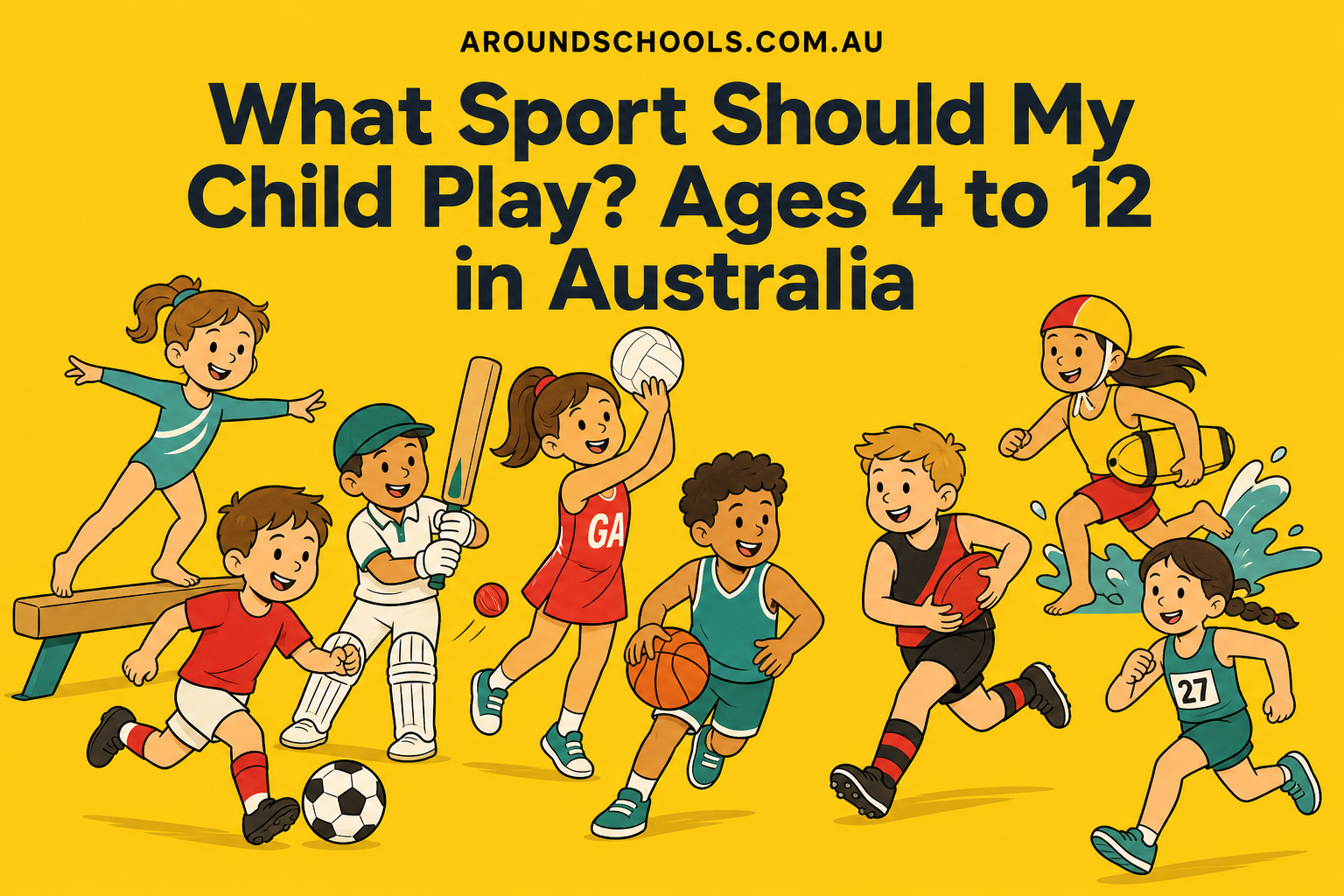
What Sport Should My Child Play? Ages 4 to 12 in Australia
21 September 2026
For most Australian families, your child's age decides more than their temperament does. Five national entry programs accept a four-year-old. Ten accept a five-year-old. By the time a child turns twelve, three do. We opened each sport's own program page on 22 September 2026 and read the ages off it, and this is what they say.
Key takeaways
- Age five is the real starting line. Ten of the eleven national programs that publish a numeric age range accept a five-year-old. At four, five do.
- The window narrows quickly. Eight programs still take a new starter at ten, five at eleven, three at twelve.
- Exactly one national price exists in the whole set. Football Australia charges a $35 fee per participant for MiniRoos Kick-Off. Every other program is priced club by club.
- Two of them let you try before you pay — AFL Auskick gives you session one free, and Cricket Blast runs a free Come and Try.
- The most popular children's activity in Australia has no club program at all. Swimming is done by 23.3% of children and is bought as lessons.
- Hockey Australia publishes no age for its junior program anywhere, and the AFL's own pages disagree with each other about Auskick.
What can my child actually start at their age?
Every age below is quoted from the sport's own national page, read on 22 September 2026. Nothing here is estimated.
| Program | Sport | Ages the sport publishes |
|---|---|---|
| KinderGym | Gymnastics | 0 to 5 |
| Coles MiniRoos Kick-Off | Football | 4 to 11 |
| Woolworths Cricket Blast | Cricket | 4 to 10 |
| Get into Rugby | Rugby union | 4 to 7 |
| NAB AFL Auskick | Australian football | 4 to 7 — but see below |
| Coles MiniRoos Club Football | Football | 5 to 11 |
| Woolworths NetSetGO | Netball | 5 to 10 |
| Ford Aussie Hoops | Basketball | 5 to 10 |
| Nippers | Surf life saving | 5 to 14 |
| Little Athletics | Athletics | 5 to 15 |
| NAB AFL Superkick | Australian football | 7 to 12 |
| Hookin2Hockey | Hockey | no age published |
Where the sports contradict themselves
This is worth knowing before you ring a club, because two of the biggest programs do not agree with their own websites.
The AFL. Its navigation labels Auskick "ages 4–7". Its FAQ says something different: "Children can start playing NAB AFL Auskick in the year they turn 5. Children can participate in Auskick until they are 12, however some States/Territories have different pathway options." It adds that for any child over eight you should call before registering. In Western Australia the rule is different again — Pre-Primary to Year 2, and the child must turn 5 by 30 June. So a four-year-old who turns five during the year is probably fine; a nine-year-old should phone first.
Cricket Australia. Its Cricket Blast program page says "for kids aged 10 and under" with no minimum. Its own kids' landing page gives the program as "Ages 4-10". We have used 4 to 10 because that is the only version with both ends stated.
Little Athletics. The home page says "aged 5 to 15". The FAQ says "for children from 5, although some Member Associations may offer age groups outside this range", and adds that a child "MUST be 3 years of age before they are able to participate" — its Tiny Tots groups for three and four-year-olds are not run in every state.
At age four you have five options. At five you have ten. At twelve you have three. Most of what parents experience as "everyone else already started" is that curve, not their child.
Which of these is a club, and which is a school program?
They are not the same commitment, and the difference matters more than the sport does.
- Club sign-on — MiniRoos, Cricket Blast, NetSetGO, Aussie Hoops, Nippers, Little Athletics. You register with a local club, turn up weekly, and usually help out.
- School-delivered — the NRL's League Stars is "a non-contact introductory rugby league program for primary school-aged children", run inside primary schools, before or after school, or in the holidays. There is nothing to find: it either runs at your school or it does not. The NRL's weekend entry point is Club Rugby League instead.
- Bought as lessons — swimming, and much of gymnastics and tennis. You pay a term at a time and there is no season.
What am I actually signing my Saturday up for?
A weekly session is shorter than most parents expect, and the block is shorter still. These are the commitments each sport publishes:
| Program | Session length | How long the block runs |
|---|---|---|
| Coles MiniRoos Kick-Off | 30 to 60 minutes | 4 to 12 weeks |
| Coles MiniRoos Club Football | — | a season of 16 to 20 weeks |
| NAB AFL Auskick | 50 to 90 minutes | not published nationally |
| Woolworths Cricket Blast | 60 to 90 minutes | not published nationally |
| Woolworths NetSetGO | 45 minutes at ages 5 to 6, up to 60 above | not published nationally |
| Ford Aussie Hoops | 45 to 75 minutes | 5 to 10 weeks |
| Little Athletics | at least one competition meet each week | September to April |
Seasons differ more than the sports admit. Little Athletics is "primarily a Summer activity — generally running from September through to April — but you can join at any time", across about 500 centres nationally. Aussie Hoops runs "all year round", in line with school terms. Nippers runs through the summer patrol season, except in the Northern Territory, Far North Queensland and Broome, where clubs patrol in the cooler months. NetSetGO says winter and spring are the most popular times, but each centre sets its own schedule.
What do Australian children actually play?
This is the reality check worth having before you commit that Saturday. The figures are AusPlay, the Australian Sports Commission's participation survey for January to December 2025, released on 30 April 2026 — the data behind our national roundup of what kids actually do.
Swimming leads by a distance at 23.3%, and it is the one big activity boys and girls do at nearly the same rate — 22.4% against 24.3%. Soccer is second at 14.3%. The codes that dominate the national conversation are each done by well under a tenth of children: Australian football 5.9%, cricket 3.4%.
The gender picture decides what the team looks like on the first day. Netball is done by 9.5% of girls and 0.6% of boys. Recreational dancing runs about 9.6 to 1 towards girls. Cricket runs about 3.8 to 1 towards boys, and soccer about 3 to 1. If your child wants to be somewhere their friends are, that ratio is the number to look at.
Does it actually matter which sport you pick?
Less than the brochures suggest.
The most-played activity in the country has no national junior club program, no season and no sign-on day — swimming is treated by Australian parents as a safety skill. Meanwhile the sports with the lowest entry ages are the ones a four-year-old is least likely to remember in a decade.
What does predict whether a child keeps going is duller: the ground is close, the session time suits your week, and the cost is survivable twice. We looked at the money separately in what kids' sport actually costs in Australia, where the research puts the average at about $4,567 per child per year and finds most families limiting participation because of it.
So the useful question is not "which sport is best". It is "which of the things my child can start at their age is within fifteen minutes of home, at a time we can make every week, at a price we can repeat next year".
What will it cost to start?
Across eleven national programs we found exactly one published national price. Football Australia sets out that the MiniRoos Kick-Off fee "is made up of two parts: a $35 Football Australia fee per participant, which covers national program support, participant packs, and administration, and a program fee (club component) that varies by club". The $35 is not the total — it is the only part of any junior sport fee in Australia that is the same everywhere.
Everything else is set locally and says so: the AFL says Auskick costs "vary between locations and Centres"; Netball Australia says prices "vary depending on your local centre"; Basketball Australia says "each Local Centre sets their own price point"; Little Athletics says fees "may differ between Centres"; Cricket Australia publishes no price at all. Anyone quoting you a single national number for junior sport has made it up.
Two of them let you find out for nothing first. The AFL offers "session one of every Auskick program free (subject to that Centre's capacity)" so a child can trial before you pay. Cricket Australia offers "a free Come and Try session (subject to centre capacity)" — speak to the centre coordinator beforehand. Several other clubs do the same informally; it is always worth asking.
And two state voucher rounds were open when we checked the government pages on 22 September 2026:
| State | Program | Value | Status on 22 September 2026 |
|---|---|---|---|
| Victoria | Get Active Kids Voucher Program | up to $200 per child | Applications now open; ages 0 to 18, Health Care Card or Pensioner Concession Card plus Medicare |
| Queensland | Play On! Sports Vouchers | up to $200 per child | Open 27 July to 18 December 2026; ages 5 to 17, one per financial year |
Queensland's page carries advice worth repeating: there are two rounds each financial year but only one voucher per child, so "if your child is playing summer sport, apply during this round". Vouchers cover membership and participation costs, not equipment or uniforms. Every state's school and activity assistance is in our state-by-state guide to help with school costs.
When do registrations open?
Not one of these programs has published a date for the 2027 season yet, which is itself useful to know in September. Auskick and NetSetGO are both still showing their 2026 seasons: Auskick's 2026 registrations opened on 1 November 2025, NetSetGO's on 1 December 2025. Treat those as the pattern to expect, not as next year's dates.
For right now, the summer programs are the live ones. Little Athletics is explicit that you can join at any time during its September-to-April season, and Cricket Australia says only that "registration open dates can vary depending on the program and your State or Territory" — so the club, not the national body, is who to ask.
Where do you find one of these near you?
Our directory is strong on the things you buy as lessons and thin on club sport, and we would rather say so than pretend otherwise. Read live on 22 September 2026, it holds 1,549 tennis listings, 1,543 swimming, 692 soccer and futsal and 302 gymnastics — against eleven listings in total across cricket, netball, basketball and surf life saving. For those four, use the sport's own club finder linked in the table above.
Where we are strong, these are real places running now:
- Elevate Football Academy in Burwood East, VIC — one of the rare listings with its weekly class times published.
- Can Do Aquatics in Southport, QLD.
- Sydney Beach Tennis School at Collaroy, NSW.
- My First Gym in Fyshwick, ACT.
- Horizon Gymnastics Club in Vasse, WA.
Search your own suburb on the activities directory, see where your suburb sits in the Kids' Activity Index, or check what is on this weekend. Busy suburbs worth a look if you are nearby: Marrickville, Glen Waverley, Coogee, Morphett Vale, Windsor and Engadine.
What we could not check, and will not guess
Tennis Australia would not serve us its Hot Shots pages. Every attempt returned a 403 from its firewall — direct, with a browser user agent, through a reader proxy, and on three different tennis.com.au addresses — while the site's robots.txt loaded normally, which means the pages exist and the block is a security rule, not a missing page. So we have published nothing about Tennis Hot Shots: no age, no season, no price. Tennis is one of the two things our own directory holds most of, and we still will not put a number next to it that we could not read.
Three smaller gaps, for the same reason: the individual age bands for Get into Rugby's two streams live inside images rather than page text; Gymnastics Australia's 2026 membership fee table does not render for us; and Surf Life Saving's per-state season dates are published as a map image. Blocked is not the same as absent — all of it exists, we just could not read it on the day.
Frequently asked questions
What is the youngest age my child can start organised sport in Australia? Four, for team sport: MiniRoos Kick-Off, Cricket Blast, Get into Rugby and Auskick all publish 4 as their starting age. Gymnastics Australia's KinderGym starts earlier again, at 0 to 5, with a caregiver taking part.
Is my child too old to start at ten or eleven? No, but the choice narrows. Eight of the eleven programs still take a ten-year-old, five take an eleven-year-old and three take a twelve-year-old. Clubs also commonly accept beginners outside the published range — ask rather than assume. The AFL specifically asks you to call before registering a child over eight for Auskick.
What sport do most Australian children actually do? Swimming, by a wide margin: 23.3% of children, ahead of soccer at 14.3%. Swimming is also the most evenly split between boys and girls.
Which sport has the fewest boys, and which the fewest girls? Netball is the most gender-split activity Australian children do — 9.5% of girls against 0.6% of boys. Cricket is the clearest the other way, about 3.8 to 1 towards boys.
How much does junior sport cost? There is no national answer. The only national price published by any of these programs is Football Australia's $35 per-participant fee for MiniRoos Kick-Off, and that sits on top of a club fee. Research puts the average across all sports at about $4,567 per child per year.
Can we try a session before paying? Yes at Auskick, where session one of every program is free subject to capacity, and at Cricket Blast, which runs a free Come and Try session. Ask any other club — many do the same without advertising it.
Can I use a state voucher for registration? In Victoria and Queensland both rounds were open on 22 September 2026, each worth up to $200 towards membership and participation fees. Neither covers equipment or uniforms.
How we checked
Every age range, session length, season and price statement in this article was read on 22 September 2026 at the national body's own page — play.afl, miniroos.com.au, play.cricket.com.au, netball.com.au, aussiehoops.basketball, sls.com.au, littleathletics.com.au, rugby.com.au, hockey.org.au, playrugbyleague.com and Gymnastics Australia's KinderGym delivery framework — and quoted as published, including where a sport contradicts itself. Participation figures are AusPlay (Australian Sports Commission), January to December 2025, released 30 April 2026; margins of error on the smaller activities are wide, from about 4 percentage points on swimming to 12.5 on athletics. Voucher amounts and dates came from getactive.vic.gov.au and qld.gov.au the same day. Directory counts are live counts of active listings in the AroundSchools directory on 22 September 2026.