Studying in Australia and Want to Stay? The 2026 Path from Student Visa to Permanent Residency
5 October 2026
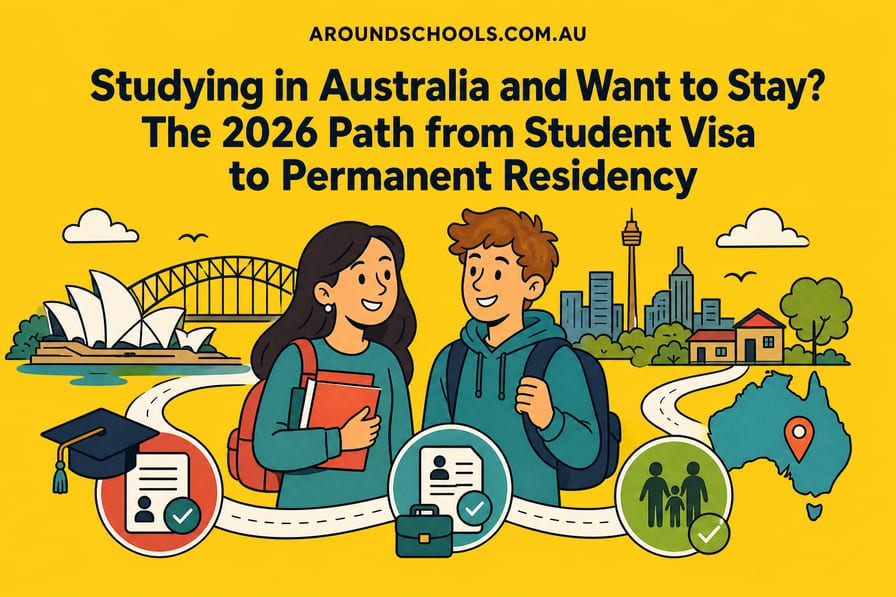
Most international students who stay in Australia follow the same three steps: a Student visa while they study, a Temporary Graduate visa (subclass 485) that gives two or three years to work after graduating, then a permanent visa through the points test, a state nomination or an employer. The government charges for those visas alone come to $14,385 for one person in 2026. And from 2 October 2026, most new student visa applicants can no longer bring a partner or children with them.
That last change matters more than any fee, and it is very new. Below is each step with the figures Home Affairs and the state education departments publish today, and a section on families that only we can write, because we already track what a student's child pays at school in every state.
Please read this first. This is general information, not advice about your situation. We are not migration agents: in Australia only a registered migration agent or an Australian legal practitioner may give immigration assistance, and you should use one before you lodge anything. We are not part of, or endorsed by, the Department of Home Affairs. Visa rules changed twice in the last month, so check the official page for your visa on the day you apply. Every figure here was read from the government's own page on 6 October 2026.
Key takeaways
- The usual path is three visas. Student visa (500), then Temporary Graduate (485), then a permanent skilled visa such as the 189 or 190, or an employer route.
- The visa charges are about $14,400 for one person. $2,500 for the student visa, $5,750 for the graduate visa and $6,135 for the 189 (or $6,140 for the 190), all from 1 July 2026. Tuition is the real cost; these are on top.
- Age matters at both later steps. You must be 35 or under to apply for the 485 (under 50 with a research masters or PhD), and under 45 when invited for the 189 or 190.
- Family rules tightened on 2 October 2026. Most new student visa applicants can no longer include a partner or children, and family cannot join later. PhD students, Pacific and ASEAN nationals and some scholarship holders are exempt.
- If your family can come, the state you study in changes your child's school bill by more than $6,000 a year for the same family.
Student to permanent resident: $14,385 in visa charges alone
Main applicant charges for one person, from 1 July 2026. Tuition, health checks and English tests are extra.
Student visa (subclass 500)
Base charge from 1 July 2026
$2,500
Temporary Graduate visa (485)
Two or three years to work after you graduate
$5,750
Skilled Independent visa (189)
Permanent. The state-nominated 190 costs $6,140
$6,135
Total, one person
Via the state-nominated 190 instead: $14,390
$14,385
So what: this is only what the government charges for the visas themselves. Tuition and living costs are the real bill; visa charges are a small, predictable part of it.
Home Affairs Legislation Amendment (2026 Measures No. 1) Regulations 2026 and Home Affairs visa pages, read 6 October 2026 · aroundschools.com.au
Step 1: Choose a course with somewhere to go afterwards
The decision that most affects whether you can stay is made before you arrive: what you study, how long the course is, and where.
- Length decides your graduate visa. The 485 gives two years after a bachelor or a masters by coursework, and three years after a masters by research or a PhD. A short course can leave you with no graduate visa at all.
- The points test rewards study here. Completing the Australian study requirement, studying in regional Australia, a Professional Year and a credentialled community language can all add points. Home Affairs' points calculator shows the current values, and the government announced on 17 September 2026 that it has redesigned the test, so check the calculator rather than an old table.
- Your occupation has to be on a skilled list for the points-tested and state-nominated visas, and states publish their own lists for the 190. Look before you enrol, not after you graduate.
If you plan to bring a partner or children, this is also where the new family rule bites hardest. More on that below.
Step 2: The Student visa (subclass 500)
The base charge is $2,500 from 1 July 2026, plus $1,530 for each additional applicant aged 18 or over and $500 for each child, where family can still be included.
What you have to show:
- Money for living costs. Home Affairs asks for evidence of $29,710 a year for the student, $10,394 for a partner and $4,449 for each child.
- That you are a genuine student. The Genuine Student requirement asks you to explain why this course, here, makes sense for you.
- Work limits. You can work up to 48 hours a fortnight while your course is in session, with no limit for masters by research and PhD students.
Australia plans for 295,000 new international student commencements in 2026, and the same number again in 2027. The government says that is a planning level, not a cap, but it does shape how quickly applications are processed: under Ministerial Direction 115, priority depends partly on how far your education provider is through its allocation.
Step 3: The Temporary Graduate visa (subclass 485)
This is the bridge between finishing your degree and qualifying for a permanent visa, and for most people it is the step that decides whether they stay.
| What you studied | How long the 485 lasts |
|---|---|
| Bachelor degree, including honours | 2 years |
| Masters by coursework, including extended | 2 years |
| Masters by research | 3 years |
| Doctoral degree (PhD) | 3 years |
The key requirements, from the Home Affairs page as updated on 24 September 2026:
- Age: 35 or under when you apply, or under 50 if you use a masters by research or a PhD (and for Hong Kong and British National Overseas passport holders).
- English: for example IELTS Academic 6.5 overall with at least 5.5 in each part.
- Cost: $5,750 for the main applicant.
- Family: today you can still include family members who are in Australia when you apply. But the Minister said on 17 September 2026 that the government will stop allowing family to be attached to graduate visas too, with the same exceptions for Pacific and ASEAN nationals and PhDs, and that families already here will not be split. No start date has been published yet, so check the page before you apply.
Studying or working in regional Australia can earn a second graduate visa of between one and two more years. Use the time to build the work experience and points that the next step asks for.
Step 4: A permanent visa
There are two broad routes, and many people try both at once.
The points-tested route. You lodge an expression of interest in SkillSelect and wait to be invited.
- Skilled Independent visa (189): no sponsor needed. You need at least 65 points and must be under 45 when invited. $6,135 for the main applicant.
- Skilled Nominated visa (190): a state or territory nominates you, usually for an occupation it needs. Under 45 when invited. $6,140 for the main applicant.
- Skilled Work Regional (Provisional) visa (491): a regional pathway that can lead to permanent residence through the 191 after living and working regionally.
An invitation is not guaranteed even above 65 points: invitation rounds favour higher scores and in-demand occupations. That is why people keep working, studying English and adding points during their 485.
The employer route. An employer sponsors you on a Skills in Demand visa (subclass 482), which replaced the old TSS visa. After at least two years of full-time sponsored work on that visa, you may be able to move to a permanent Employer Nomination Scheme visa (subclass 186). You usually need to be under 45, and it costs $6,140 for the main applicant.
If you want to bring a partner or children
This changed on 2 October 2026, so most advice online is already out of date.
Most new Student visa applicants can no longer include family members, and Home Affairs says family members "cannot apply as a subsequent entrant (at a later time, separate from your application) in any circumstance". The exceptions are:
- doctoral (PhD) students;
- students sponsored by the Department of Defence or Foreign Affairs and Trade;
- some foreign government scholarship recipients;
- eligible nationals of Pacific Island and ASEAN countries;
- some current Student visa holders, for example when progressing to a higher-level course.
If your family can come, or is already here on your visa, school is usually the biggest cost you have not planned for. Your child can go to a government school, but in most states a student's child pays tuition, and the amount depends on the state and on what you study.
If you study a coursework degree, your child’s public primary school costs this much a year
Government primary school tuition for a child of a student visa (500) holder, 2026, by state
Victoria
Dependant rate. Ask whether a research degree exempts your child
$13,600
Queensland
$314 a week. From 6 Oct 2026 free only for research degrees and listed scholarships
about $12,560
ACT
Research students in the ACT can apply for an exemption
$11,100
New South Wales
Free for most PhD students at NSW universities
$7,800
Tasmania
Free for postgraduate research students
$7,600
South Australia
No exemption for PhD students on the dependants schedule
$7,120
So what: a PhD usually makes your child’s place free (South Australia is the exception), and the same family pays over $6,000 a year more in Victoria than in South Australia.
Each state education department’s 2026 schedule, read 6 October 2026. Queensland is its weekly rate over a 40-week school year · aroundschools.com.au
A PhD usually makes your child's place free. New South Wales, Queensland, Tasmania and the ACT all exempt, or let you apply to exempt, the children of research students, and Western Australia waives the fee for dependants of PhD and masters by research students at a WA university. South Australia is the exception: its dependants schedule charges the same $7,120 for a primary child whatever the parent studies.
For a coursework degree, the state is the difference. The same primary-school child costs $13,600 a year in Victoria and $7,120 in South Australia, a gap of $6,480, every year, per child. Western Australia asks dependants to enrol as full fee-paying overseas students unless a waiver applies, and from 1 January 2027 that waiver no longer covers masters by coursework. In the Northern Territory, ring the international education team and ask what your subclass pays.
Two things to check before you choose a city:
- The exemption rules changed this month in Queensland. From 6 October 2026, a student's child goes free only if the parent is doing a research degree or holds a listed scholarship. Everyone else pays $314 a week for primary school.
- Application fees and school levies sit on top. For example, $150 in New South Wales, $305 in Queensland and $720 per family in the first year in South Australia.
Our guide to school fees for visa families covers every state and every common visa, including the skilled work visas many graduates move onto, where two states charge nothing at all.
Settling in once you know the city
When you are weighing two cities, the school fee belongs next to the rent and the salary. Then look at the suburbs themselves:
- Find your local government school with the school catchment checker: in most states your address decides which school must take your child.
- Compare schools in our school directory, and read our guide to public, Catholic and independent schools if the systems are new to you.
- See what children do after school in each suburb with our activity data, or browse kids' activities near where you might live.
Three things to do this year
- Check your age against the deadlines. 35 for the 485 (50 for research degrees), 45 for an invitation. If you are close, the order in which you do things matters.
- Read the official page for each visa on the day you apply, not a guide written before October 2026. The family rules changed on 2 October and a further change has been announced.
- Talk to a registered migration agent before you lodge. You can check any agent's registration on the MARA register.
Frequently asked questions
How long does it take to get permanent residency after studying in Australia?
There is no fixed time. The path is the length of your course, then two or three years on a 485 while you build work experience and points, then an invitation, which is not guaranteed. For a two-year masters by coursework, that is four years on the clock before the 485 runs out, so it pays to start building points early.
How much are the visa fees from student visa to PR?
For one person in 2026: $2,500 for the Student visa, $5,750 for the Temporary Graduate visa and $6,135 for the Skilled Independent visa (189), or $6,140 for the 190. That is $14,385 via the 189. Health checks, English tests and skills assessments cost extra.
Can I bring my family on a student visa in 2026?
Since 2 October 2026, most new Student visa applicants cannot include family, and family cannot join later. PhD students, Defence or Foreign Affairs sponsored students, some scholarship holders and eligible Pacific and ASEAN nationals are exempt.
What is the age limit for the 485 visa?
You must be 35 or under when you apply, or under 50 if your qualification is a masters by research or a PhD, or you hold a Hong Kong or British National Overseas passport.
Do my children pay school fees if I'm on a student visa?
In most states, yes, unless you are doing a research degree. In 2026 a primary-school child costs from $7,120 a year in South Australia to $13,600 in Victoria. PhD students' children go free in most states, but not South Australia.
Related reading
- School fees for visa families: where your child's place is free
- How to find your school catchment area: a state-by-state guide
- Public vs Catholic vs independent schools: how to choose
How we checked: visa charges from the Home Affairs Legislation Amendment (2026 Measures No. 1) Regulations 2026 and the Home Affairs pages for each visa; family rules from the Student visa page and the Minister's National Press Club speech of 17 September 2026; school fees from each state education department's 2026 schedule. All read on 6 October 2026.