School Fees for Visa Families: Where Your Child's Place Is Free
Live listings refreshed 27 Sept 2026 · Last updated 27 Sept 2026
For primary and secondary school (Prep to Year 12). A companion guide for university students, and a combined one, are planned.
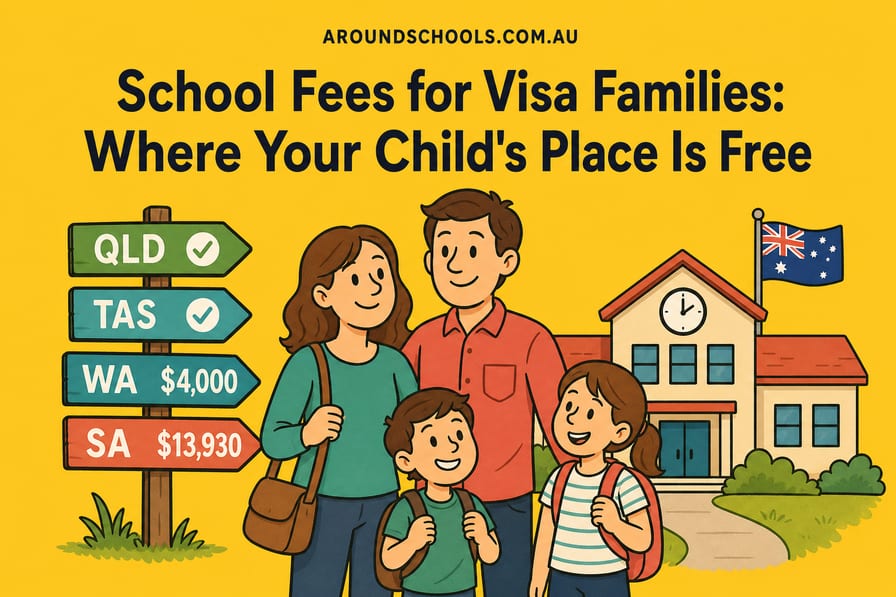
In Queensland and Tasmania, a child whose parent holds a skilled work visa goes to a government school for nothing. In South Australia the same child costs $6,700 a year for primary and $7,900 for high school. Same visa, same child, different state.
That is worth knowing while the choice is still open, because for most families it is open. You usually pick the state after the visa, when you are weighing a job offer, a university or a suburb — and the school figure belongs in that comparison alongside the salary and the rent.
Your visa sets the bill, but the state collects it, and the states do not agree with each other. Below is what each one charges in 2026, every figure read from the department's own current schedule.
Please read this first. This page is general information about school fees for primary and secondary students, not advice about your situation. We are not migration agents: in Australia only a registered migration agent or an Australian legal practitioner may give immigration assistance, and if your circumstances are not straightforward you should use one. We are not part of, and not endorsed by, any education department or the Department of Home Affairs. Every figure here is dated and linked to the department that published it — fees are reset annually and visa rules change more often than that, so confirm your own subclass with the relevant department before you enrol or sign anything. A separate guide for university students, and a combined one, are planned.
Key takeaways
- Two states charge skilled visa families nothing. Queensland and Tasmania exempt children of 482 holders from tuition entirely.
- One state charges per family, not per child. Western Australia asks $4,000 a year however many children you enrol, which makes it the cheapest place in the country to bring three or four.
- Your visa subclass, not your income, decides it. A skilled worker and a postgraduate researcher in the same street can get opposite answers at the same school.
- The spread is worth planning around. Two children for the 2026 year cost nothing in Queensland or Tasmania, $4,000 in Western Australia, close to $14,000 in South Australia, and up to $25,600 in the ACT if its exemption is not granted.
- Check it before you sign a lease or accept an offer. The fee follows the state you live in, and it is usually the largest cost difference between two otherwise similar cities.
Three things to do this week
If you are mid-decision, these take an afternoon and can be worth five figures.
- Find your subclass number. It is on your grant letter, and it is the only thing the school system looks at. Not your job, not your income, not how long you plan to stay.
- Ring the temporary residents team in the state you are considering and ask what that subclass pays. Every state has one, and they will tell you over the phone. Ask about the application fee and the school's own levies too, because those sit outside the tuition figure.
- If you are choosing between two states, put the school number next to the salary. A job paying $8,000 more in Adelaide than in Brisbane can leave a two-child family behind once the school fee is counted.
If your visa is about to change — a student finishing a course, a graduate moving onto a skilled visa — ask how a mid-year change is handled before you assume anything is refunded.
Your visa sets your school bill, and nobody warns you
Australia grants visas federally and runs schools at state level. Those two systems were never designed to line up, and for families with children the seam between them is expensive.
When a state calls your child a "temporary resident", it is deciding fee liability from your visa subclass. Every state publishes a table mapping subclasses to fee outcomes. The tables do not agree with each other. A subclass that is exempt in Brisbane is chargeable in Adelaide, and the difference for a family of four can exceed the cost of a car.
This has nothing to do with the quality of the school, your tax residency or how long you intend to stay. It is purely which table your address falls under.
What each state charges in 2026
Queensland
Children listed as dependants on a skilled work visa — subclass 482 and the skilled provisional visas alongside it — are fee exempt, and do not need an Authority to Enrol before starting. That is unusually generous and worth knowing before you choose between Brisbane and a southern capital.
Children of student visa holders are a different case. They are charged per week, per child: $314 a week for Prep to Year 6, rising through $322 for Years 7 to 9 to $396 for Year 12, plus a $305 application fee. Over a forty-week school year that is roughly $12,600 for a primary child and about $15,800 for a Year 12 student. A specific exemption exists for some categories of student visa holder and applies only while the parent's own course runs, so ask Education Queensland International which category you fall into before you enrol.
Western Australia
Western Australia does something no other state does: it charges one fee for the whole family. Dependants of 457 and 482 visa holders pay $4,000 a year regardless of how many children are enrolled from Pre-primary to Year 12, and nothing at all if the oldest child is still in Kindergarten.
For a family with three or four school-age children, one flat fee is the lowest total in the country. For a family with one child it is $4,000 where Queensland charges nothing and South Australia charges $6,700 to $7,900. The tuition fee is waived entirely for dependants of a masters or PhD student at a Western Australian university.
South Australia
South Australia charges per child, and it is the most expensive of the states that publish their rates openly. For 482 visa families the 2026 maximum is $6,700 a year for primary school and $7,900 for high school, with a 10% discount for each child after the eldest.
Two things soften it, and both are worth checking rather than assuming. Families with a household income of $75,000 or less are exempt, and reduced fees apply on a sliding scale up to somewhere between $101,000 and $139,000 depending on how many children are enrolled. Certain country-area schools are also exempt, so the same family can pay nothing an hour outside Adelaide and $13,930 inside it.
Dependants of international tertiary students pay slightly more again: $7,120 a year for Reception to Year 6 and $8,400 for Years 7 to 12, plus a $720 family application fee in the first year and $370 per child after that.
Tasmania
Tasmania exempts dependants of 482 visa holders from tuition entirely. They pay a $150 application fee and the school's own levies, and nothing else.
Where tuition does apply — a dependant of a higher-education student visa holder, for instance — the Temporary Resident Program rate is $3,800 a year for Kindergarten and $7,600 for Prep to Year 12, also quoted as $1,900 a term or $190 a week. The first two terms must be paid before an Authority to Enrol is issued.
Do not use the larger figures on Tasmania's main fees page. Those $13,800 to $16,000 amounts are the International Student Program, for a child holding a student visa in their own name, and that page routes temporary residents elsewhere. It is an easy and expensive thing to misread.
Tasmania also has the most generous hardship arrangement in the country, and it is graduated rather than all-or-nothing: relief of 100%, 75%, 50% or 25% by household income, with the threshold rising for each child. One child qualifies for full relief under $64,500; five or more children under $116,000. The thresholds are reviewed each November. One important exclusion: subclass 500 is shut out of relief on both grounds, so a student visa dependant is fee liable and cannot apply.
Australian Capital Territory
The ACT publishes the clearest table in the country and charges per child per year: $4,200 for preschool, $11,100 for primary from Kindergarten to Year 6, $14,500 for Years 7 to 10 and $16,200 for Years 11 and 12, plus a $265 application fee.
The important word is apply. The ACT's column is headed "can apply for a fee exemption", not "is exempt" — nothing here is automatic. A 482 holder can apply, but has to show an ACT employment contract in a skilled occupation or a labour agreement, and be working and living in the ACT. Dependants of postgraduate and Masters by Research students can apply too.
One line in the ACT's waiver guidelines is worth knowing before you plan around a hardship application: fee waivers are not available for a child holding a subclass 500 school-sector visa in their own name.
Northern Territory
The Northern Territory charges temporary residents and publishes the detail on its own site, which does not serve automated checks. We are not printing a figure we could not read at source. Ring the international education team before you enrol, and ask specifically what your subclass pays rather than what an international student pays — those are different numbers everywhere else, and they will be here too.
New South Wales and Victoria
Both states run a fee for temporary residents, and both publish the detailed subclass tables to schools rather than to families.
In New South Wales most temporary residents pay an application fee and a tuition fee, some subclasses are exempt, and there is an appeal route for low family income. Visitor visas, short stays of thirteen weeks or less, and dependant student visa holders cannot use that appeal. Ring the Temporary Residents Program for the rate that applies to your subclass.
Victoria decides liability from an international student visa fee table that it issues to schools. Children listed as dependants on a parent's visa are treated as a separate category from students holding a visa in their own name. Contact the International Education Division and quote your subclass before you accept a place, because the answer genuinely differs by subclass rather than by school.
English support for a child who is new to it, and the deadline nobody mentions
Both big states run intensive English programs for newly arrived children, and both attach a clock to them that starts the day you land.
New South Wales runs Intensive English Centres attached to high schools, plus standalone Intensive English High Schools. A child must apply within six months of arriving in Australia, must speak a language other than English as a first language, and must intend to continue in a government high school afterwards. Most students stay up to three terms, or four where there are additional needs. Temporary visa holders are eligible and enrol through DE International, so the tuition rules above still apply. Year 6 children can transfer in if they turn 11 by 31 July of the enrolment year. Children on visitor visas of three months or less, working holiday visas, or exchange programs are not eligible.
Victoria runs English language schools and centres across Melbourne plus regional programs in Geelong, Mildura and Shepparton, with a Virtual New Arrivals Program for families outside those areas. Students typically attend for six to twelve months. The window is eighteen months from arrival for a child starting Foundation and six months for every other year level.
The Victorian eligibility rule is worth reading twice, because it links the two halves of this page. A child qualifies if they hold "a visa that entitles them to enrol in a Victorian government school and that attracts Student Resource Package funding". That is the same funding test that decides fee liability. So in Victoria your visa can determine not only what you pay, but whether your child can get into the intensive English program at all. Ask the department about both in the same phone call.
If your child needs this, it moves the enrolment conversation forward by months. Six months sounds generous until you have found a rental, waited on a shipping container and enrolled two children.
What you pay beyond the tuition figure
The headline fee is not the whole bill, and the extras are charged by the school rather than the department.
- Application and administration fees. Queensland charges $305 on application and again for a change of school. South Australia charges $720 per family in the first year and $370 per child after that. Tasmania charges an application fee even where tuition is exempt.
- Materials and services charges. South Australia's own schedule puts these between $110 and $920 per child per year, paid directly to the school, and the range is about that wide everywhere. Ask the specific school, not the department.
- Uniforms, books, excursions, camps and devices. Budget for these separately in every state. South Australia's published guidance suggests $150 a year for stationery, $250 to $500 for uniform, $50 to $100 for excursions and $100 to $300 for a camp.
- School levies where tuition is exempt. Tasmania exempts 482 dependants from tuition but still charges levies, so "fee exempt" is not the same as "free".
A useful rule when comparing two states: ask each school for its total compulsory annual cost, not its tuition. It is the only number every school can actually answer.
The pathways, in plain English
The visa system itself is federal and changes often — charges and points thresholds are reset each July, and occupation lists move more frequently than that. So this section tells you what each pathway is for and sends you to the official page for every current number. We deliberately do not restate fees or points here, because a stale figure on a page like this is worse than no figure at all.
Permanent skilled visas are the main route for people with no employer and no Australian family. The Skilled Independent visa needs no sponsor and is points tested. The Skilled Nominated visa adds a state or territory nomination, which is often the difference between a passing score and a winning one. The Skilled Work Regional visa is provisional rather than permanent and leads to permanence after you have lived and worked in a designated regional area.
Employer-sponsored visas run in parallel. Subclass 482 is the main temporary one — the state school documents quoted above still call it Temporary Skill Shortage, and it has been renamed since, which is a good illustration of why you should read the current page rather than any summary. Several of its streams lead on to a permanent employer-nominated visa. If you already have an Australian employer willing to sponsor you, this is usually faster than accumulating points.
Family visas cover partners and children, and separately parents. Partner visas run as a provisional grant followed by a permanent one. Parent visas divide into contributory and non-contributory, and the queue is the thing to look at rather than the brochure: Home Affairs publishes both the date it has reached in the queue and an estimated wait. Read those two numbers on the day you plan, and do not build a schooling plan around a grandparent arriving on a parent visa until you have.
Other arrangements exist for specific groups: New Zealand citizens have their own category and, since 2023, a direct path to citizenship; working holiday arrangements differ country by country in both the age limit and whether a ballot applies; and there are dedicated programs for Pacific nations.
For all of these, the Department of Home Affairs site is the only authority worth relying on, and it is the one place where the number you read today is the number that applies today. Start at its visa finder rather than at any summary, including this one.
We are not migration agents and this is not immigration advice. In Australia only a registered migration agent or an Australian legal practitioner may give immigration assistance. If your situation is not straightforward, use the official register to find someone qualified. What we can tell you about is schools.
If you are already here on a student visa
This is the most common version of the question we get, and it has a particular sting in it. While you study, your children are usually treated as student visa dependants, which is the most expensive category in most states. If your course leads to a post-study work visa and then to a skilled visa, that classification changes — and in Queensland and Tasmania it changes to nothing at all.
Two practical consequences. First, the year in which your visa changes can be worth thousands, so ask the department how mid-year changes are handled before you assume a refund. Second, if you are weighing two universities in different states, the school fee difference for your children may be larger than the difference in your own tuition. That is not a comparison anyone puts in a prospectus.
Before you choose a city
Once you know what your visa costs you, the rest of the decision is the ordinary one every Australian family makes: which schools are near, what the catchment looks like, and what there is for children to do outside school hours.
- Browse schools by state and filter by sector, level and gender in our school search.
- Check whether an address falls inside a government school zone with the catchment checker.
- See what published fees look like at non-government schools in New South Wales, Victoria and Queensland — useful context, because in some states a temporary-resident government place costs more than a low-fee private school.
- Look at what is actually on for children near a suburb in our activities directory.
Frequently asked questions
Does my child get a free government school place if I am on a 482 visa? In Queensland and Tasmania, yes for tuition. In Western Australia you pay $4,000 for the whole family. In South Australia you pay per child unless your household income is under $75,000 or the school is in a listed country area. In New South Wales and Victoria, ask the department for your subclass.
Do permanent residents pay? No. Permanent visa holders are treated as local students everywhere, and Tasmania states plainly that all permanent visa holders are exempt from both the application fee and tuition.
What about non-government schools? Independent and Catholic schools set their own fees and generally charge the same amount regardless of visa, though some charge an international rate. South Australia's temporary-resident fee does not apply to non-government schools at all.
Do these fees cover everything? No. Uniforms, books, excursions, camps and technology are charged separately by the school in every state, and South Australia's own schedule puts those materials and services charges between $110 and $920 per child.
Can I appeal if I cannot afford it? Yes in several states. New South Wales has a low-income appeal, Tasmania has a fee relief policy you can apply for at any time, South Australia has an income test built into the rate, and Western Australia accepts financial hardship applications.
Do I need permission before my child can start? It depends on the state and the subclass. In Queensland a dependant of a 482 holder needs no Authority to Enrol and can approach a school directly, while a student visa holder's dependant does need one first. Tasmania requires an application even where tuition is exempt. Ask before you assume you can simply turn up in week one.
What happens if my visa changes mid-year? Ask the department in writing before the change. Queensland charges by the week and Tasmania and South Australia charge by the term, so the point in the year at which your classification changes affects what you owe — and a refund is not automatic. This is the single most common way families lose money on this.
We are on a bridging visa while we wait. What do we pay? In Victoria the answer follows the visa you held immediately before the bridging visa: if that one was fee exempt you stay exempt, and if it was fee liable you keep paying. Other states assess bridging visas case by case, so confirm rather than assume.
Is kindergarten or preschool treated the same way? No, and the difference can work in your favour. Western Australia charges no family tuition fee at all if your oldest child is still in Kindergarten. Queensland charges a lower weekly rate for State Kindergarten than for Prep. Ask specifically about the year before school, because it is often priced separately.
Does any of this apply to Catholic or independent schools? Largely no. Non-government schools set their own fees and usually charge the same regardless of visa, though some have a separate international rate. South Australia's temporary-resident fee explicitly does not apply to them. In a state with a high government-school fee, a low-fee Catholic school can genuinely work out cheaper — worth pricing both.
Will my child get help with English? Probably, and there is a deadline. See the section above: six months from arrival in New South Wales, and six to eighteen months in Victoria depending on year level.
Sources and official pages
Everything on this page is linked to the department that published it. These are the pages to ring or read for your own situation — they outrank us, and they outrank any migration agent's summary.
Fees and enrolment, by state
- Queensland — Temporary Residents Admissions fees and the schedule of visa subclasses and enrolment conditions; fee exemptions policy
- Western Australia — Enrolment framework for students with a visa in public schools
- South Australia — student fees for families on 482 visas and the 2026 dependant fee schedule
- Tasmania — Temporary Resident Program fees, the visa schedule and the fee relief policy
- New South Wales — international students and visa holders for parents, and the enrolment of temporary residents procedures behind it. Fees are quoted by the department's Temporary Residents Program on 1300 300 229.
- Victoria — International Student Program policy
- Australian Capital Territory — enrol a child dependant of a temporary resident and the fee waiver guidelines
- Northern Territory — school fees for international students
English language support for new arrivals
- New South Wales — Intensive English Centres
- Victoria — EAL provision for newly arrived students
Visas
- Department of Home Affairs — the only authority on visa charges, points and processing times
- Register of migration agents — to check that anyone charging you for immigration help is allowed to
How we checked
Every figure on this page was read from the responsible department's own current schedule on 27 September 2026, not from a summary or an agent's site. Queensland's rates come from its Temporary Residents Admissions fee schedule dated June 2026; Western Australia's from its enrolment framework effective February 2025; South Australia's from its 2026 dependant fee schedule and its 482 families page; Tasmania's from its Temporary Resident Program fee table, its visa schedule published December 2025 and its fee relief policy version 13; the ACT's from its enrolment page last updated 14 September 2026 and its fee waiver guidelines; and the New South Wales and Victorian rules from each department's own policy, updated January 2025 and June 2026.
Three jurisdictions are missing a number here on purpose. New South Wales and Victoria publish their dollar rates to schools rather than to families. The Northern Territory publishes its rates openly but its site refuses automated reading, and two attempts through a text proxy returned two different tables — with the temporary-resident band being exactly the one that did not reproduce. So for those three, ring the department and ask for the rate that applies to your subclass. Tasmania is the reason this matters: its public fees page carries numbers between $13,800 and $16,000 that look like the answer and are not, and only the separate temporary-resident table gives the real one.
No visa charge, points score or processing time appears anywhere on this page, and that is deliberate. Those numbers reset every July, and the only place they are right on the day you apply is the Department of Home Affairs itself. Read them there, and treat a visa fee quoted on any other website — including this one — as out of date until you have seen it on the official page.