Cricket Blast: What Age, What It Costs and When Your Season Actually Starts
24 September 2026
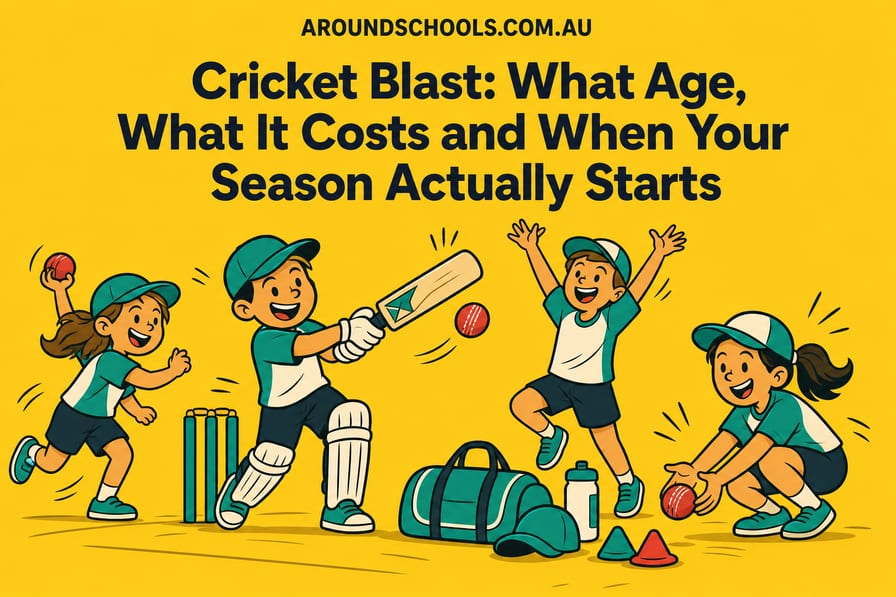
Cricket Blast is Cricket Australia's entry program for children aged 4 to 10, and it has a published RRP of $99 for a season the organisation recommends running over 8 weeks of "weekly 60-90 minute sessions". That works out at about $12.38 a session, or roughly $8.25 to $12.38 an hour — our arithmetic on their two published figures. A participant pack is included in the fee.
There is no national start date. Cricket Australia says plainly that "registration open dates can vary depending on the program and your State or Territory". What is fixed is the school calendar most centres follow, and Term 4 2026 begins between 5 and 19 October depending on where you live.
Key takeaways
- Ages 4 to 10. Cricket Australia's own pages now say "Ages 4-10" and "For kids aged 10 and under".
- The old names are gone. "Junior Blasters" and "Master Blasters" are retired branding — there is now one Cricket Blast program. A club still advertising Master Blasters is using an old label.
- RRP $99, including a Cricket Blast Pack. Clubs set their own price, so treat $99 as the benchmark, not a ceiling.
- About $12.38 a session at the recommended 8 weeks — among the cheapest organised sport in the country, though footy's cheapest published season undercuts it.
- A voucher covers the entire registration in every state and territory except the ACT, and in Western Australia it covers it five times over.
- Term 4 starts a fortnight apart across the country, so there is no national week when cricket begins.
- More than 90% of cricketers start by age 12, on Cricket Australia's own figure — which is why the entry program matters more than it looks.
What age can my child start cricket?
Four. Cricket Australia lists Cricket Blast as "Ages 4-10" and describes it as "a fun-first program designed for kids to learn through exciting activities and modified games". Its own program page puts it as "For kids aged 10 and under".
The important thing to know in 2026 is what the program is not called any more. For years Blast was split into "Junior Blasters" for 5 to 7 year olds and "Master Blasters" for 7 to 10 year olds, and those names are still all over club websites, old flyers and search results. Cricket Australia's live pages no longer use either term. There is now a single Cricket Blast for the whole 4 to 10 band, with unnamed internal levels that the local centre pitches to the children in front of it.
So if you land on a club page advertising Master Blasters, it is not a different program and it is not a mistake worth worrying about — it is a page that has not been updated. Ask the club which age groups it is actually running this season.
Girls' options vary by area rather than nationally: Cricket Australia says "Cricket Blast may be mixed or in some local areas, girls only programs will be offered", and that "many clubs have all girls junior cricket teams playing in mixed or all girls competitions". If a girls-only group matters to your child, that is a question for the local club, because no national rule guarantees one.
What does Cricket Blast cost?
Cricket Australia publishes something most sports do not: an actual number. "Woolworths Cricket Blast has an RRP of $99." It appears on two separate Cricket Australia pages.
Read "RRP" carefully, though. It is a recommended price, not a fixed one — Cricket Australia tells clubs to "review what other programs in your area charge", and to factor in extras like medals, trophies and club shirts. So $99 is the benchmark your club starts from, and some charge above it.
At the recommended 8-week season:
| Season length | Cost per session, at $99 |
|---|---|
| 8 weeks (Cricket Australia's recommendation) | $12.38 |
| 10 weeks | $9.90 |
Sessions run 60 to 90 minutes, so per hour that is roughly $8.25 to $12.38. For comparison, the cheapest published Auskick season in the country works out at $4.64 to $6.50 an hour, and a term of tennis runs $12 to $37.50 a session. Cricket sits in the middle, and the fee includes gear.
What the fee buys, besides the sessions, is a Cricket Blast Pack — Cricket Australia says "each registered participant receives a Cricket Blast Pack" and that there are "currently two pack options: a Starter Pack (ideal for new participants beginning their Cricket Blast journey) and a Progression Pack (perfect for returning participants)". Packs come in "W/BBL and Australia colours or Indigenous Deadly Designs". For a first-timer that removes the usual second bill, because you are not buying a bat before you know whether they like it.
The voucher covers the whole thing
At $99, cricket sits below every state voucher in the country. Cricket Australia names the schemes on its own club resources page — "State Government Sports Vouchers are subsidies for parents and guardians, so kids can participate in sport" — and links all eight jurisdictions.
Each figure below was read on its own government page on 24 September 2026:
- Western Australia — KidSport. Up to $500 per financial year, for children 5 to 18 named on a Health Care Card or Pensioner Concession Card. Applications are open year round, new rounds begin 1 July, and each voucher is valid 90 days. Covers "registration, membership or participation fees".
- Victoria — Get Active Kids. Up to $200 per child. Round 11 is open now and closes at 10am on 13 October 2026, or earlier if the budget runs out — that is the tightest deadline on this page. Ages 0 to 18, Health Care Card or Pensioner Concession Card plus Medicare. Explicitly covers "membership and registration fees".
- Queensland — Play On! Sports Vouchers. Up to $200 for each child aged 5 to 17, one per financial year. Applications opened 27 July 2026 and close 18 December 2026; present the voucher by 18 June 2027. Covers "membership or participation costs". Note this replaced FairPlay — if you are looking for FairPlay, that is the scheme it became.
- South Australia — Sports Vouchers. Two of $100 per child per calendar year. Currently Reception to Year 9, and worth diarising: from 1 January 2027 it widens to all South Australian children aged 5 to 18.
- Tasmania — Ticket to Play. Two vouchers worth up to $100 each, ages 5 to 18, for children on a health care or pensioner concession card or in out-of-home care. Applications are open from 6 July 2026 until 28 May 2027, and vouchers must reach the provider by 4 June 2027.
- Northern Territory — Sport Voucher Scheme. Two $100 vouchers a year for "every enrolled and home-schooled child from transition to year 12". Rounds open around July and January — check sportvoucher.nt.gov.au for this round's exact dates, as the scheme's own page had not been updated when we checked.
- New South Wales — Active and Creative Kids. $50, twice a year, for children 4.5 to 18 whose carer receives Family Tax Benefit. One is available from 15 January, the second from 15 July, and two unexpired vouchers can be combined.
- Australian Capital Territory. The ACT runs no per-child sport voucher. ACT families should instead apply to the Future of Education Equity Fund, worth $400 for preschool, $500 primary and $750 for high school and college, which lists "sporting activities" among its covered costs. Applications are open until 27 November 2026.
Apply the code when you register, not afterwards. Cricket Australia confirms vouchers are accepted and Cricket NSW notes that all its affiliated clubs and Blast centres are registered providers so parents "redeem their voucher (if applicable) when registering". Some sports are stricter still — Netball Queensland states outright that applying a voucher to a registration already completed breaches its terms. Getting the code first is the safe habit everywhere.
When does the season start?
Cricket Australia will not give you a date, and it is honest about why: "registration open dates can vary depending on the program and your State or Territory." Clubs are told to start planning roughly four months out, which is why registrations tend to appear from late winter for an October start.
What you can pin down is the school calendar, because most Blast centres run on it. Term 4 2026 begins:
| State or territory | First day of Term 4 2026 |
|---|---|
| Victoria | Monday 5 October |
| Queensland | Tuesday 6 October |
| Western Australia | Monday 12 October |
| South Australia | Monday 12 October |
| New South Wales | Tuesday 13 October |
| Australian Capital Territory | Tuesday 13 October |
| Tasmania | Monday 19 October |
Those are the government student attendance dates we publish on our school holidays pages. A Victorian child is back at school a full fortnight before a Tasmanian one, so "cricket starts when school goes back" means seven different weeks. Independent and Catholic schools drift by a few days — and your cricket club is not a school, so confirm its first session with the club rather than assuming.
Blast, Smash or a club team?
Cricket Australia publishes three steps, and they overlap more than parents expect.
Cricket Blast (4 to 10) is the entry program: weekly 60 to 90 minute sessions, modified games, equipment provided, pack included.
Smash Series Cricket (9+) is the newer middle step — "a fast, simplified format born from the backyard… for those new to cricket, moving on from Cricket Blast, or just wanting a fun way to stay in the game", compressed into one hour.
Junior Club Cricket (8 to 18) is real cricket with "shorter pitches, modified rules and stage-based progression", laddered as Stage 1: Learn the Game (11 and under), Stage 2: Play and Compete (under 13) and Stage 3: Play, Compete and Grow (14+).
Because all three overlap between 8 and 10, a nine-year-old genuinely has three options. The useful question is not which is most advanced but how long you want to stand at a ground on a Saturday: Blast is an hour or so on a weeknight or weekend morning, Smash caps itself at an hour, and club cricket is a morning.
Why any of this matters more than it looks: Cricket Australia's own participation strategy states that "more than 90% of players start playing cricket by the age of 12". Whatever else that means, it means the entry program is not a warm-up act — for most players it is the door.
Finding a club near you
Here is the honest position. Cricket is run overwhelmingly by volunteer clubs, and volunteer clubs mostly do not list themselves in online directories — ours included. We list 1,549 tennis programs and 1,543 swim schools, because those are taught by commercial businesses that market themselves, but only a handful of cricket clubs. That is a fact about who does the marketing, not about how much cricket there is.
So for cricket, the fastest route is Cricket Australia's own club and centre finder at play.cricket.com.au, which is the authoritative list and the one clubs actually keep current.
A few cricket clubs we do list, each checked live today:
- Eltham Collegians Cricket Club at Research, north-east of Melbourne
- Warrandyte Cricket Club and Pines Cricket Club at Frankston North
- North Geelong Cricket Club at Rippleside
- Ryan Mason Cricket Coaching on the Gold Coast, for one-to-one work
And to see what else runs in the same week near you, our suburb pages cover the whole activity mix — for example Warrandyte, Research and Frankston North. Browse kids' activities for your own suburb, or the national picture in our Kids' Activity Index.
Frequently asked questions
What age can a child start cricket in Australia?
Four. Cricket Australia's Cricket Blast is published as "Ages 4-10" and "for kids aged 10 and under".
How much does Cricket Blast cost?
It has a recommended retail price of $99, which includes a Cricket Blast Pack. Clubs set their own price from that benchmark, so some charge more. At the recommended 8-week program that is about $12.38 a session.
What happened to Junior Blasters and Master Blasters?
They are retired names. Cricket Australia now publishes a single Cricket Blast program for ages 4 to 10. Clubs still advertising Master Blasters are using old branding, not running a different program.
Can I use a government sports voucher for cricket?
Yes, in every state and territory except the ACT, which has no sport voucher and offers the Future of Education Equity Fund instead. At a $99 registration the voucher covers the whole fee everywhere it exists. Apply the code when you register.
When does junior cricket start?
Cricket Australia publishes no national date and says start dates vary by state and program. In practice most centres begin around the start of Term 4, which in 2026 falls between 5 and 19 October depending on your state.
Do I need to buy a bat?
Not to start. Cricket Australia says equipment is provided at Blast sessions and a participant pack is included in the registration fee.
What comes after Cricket Blast?
Smash Series Cricket from age 9, a simplified one-hour format, or Junior Club Cricket from age 8, which runs Stage 1 for 11s and under, Stage 2 for under 13s and Stage 3 from 14.
How we checked
Program ages, the $99 RRP, session and season lengths, the participant packs, the voucher statement and the pathway steps were all read on Cricket Australia's own pages at play.cricket.com.au and cricket.com.au on 24 September 2026. The per-session figures are our arithmetic on Cricket Australia's published price and its 8-week recommendation, not figures it publishes.
Two things we deliberately left out. Cricket Australia's support site was decommissioned and its help articles now return errors, so the old Junior Blaster and Master Blaster age splits could not be confirmed on any live page — we have described the current program instead of repeating retired names. And the most recent participation census we could read directly is 2022-23, which recorded Cricket Blast registrations rising 24% to 69,879 and junior club cricket steady at 108,100 children; Cricket Australia reported in October 2025 that 473,000 participants had registered for Blast since 2018. We have not quoted the newer annual report, whose figures we could not open.
Voucher amounts, eligibility and dates come from each government's own program page, read the same day. The Northern Territory scheme's page still showed a 2021 round when we checked, so we have given its value and eligibility but no round dates. School term dates are the government student attendance dates we publish on our school holidays pages. Prices and voucher rules change — check both before you pay.